
Arbitration is usually a creature of contract. Parties arbitrate because they have agreed to do so. Próspera ZEDE departs from that model by embedding arbitration into its legal architecture, making it the default mechanism for a significant category of disputes even when the parties’ contract is silent. It also creates two distinct tracks: a private, confidential ADR process and a public, precedential adjudicative system. The choice between them is not always in the parties’ hands.
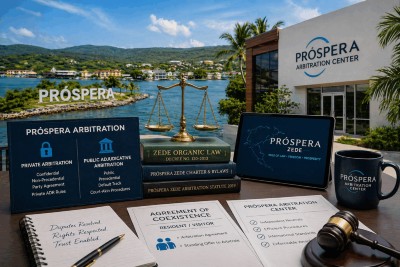 Próspera itself warrants a brief introduction for readers new to the subject. Próspera ZEDE is not a conventional special economic zone. Located in Honduras, with territory on Roatán and near La Ceiba,[1] it was designed as a far more ambitious project: a private “startup city”[2] with its own published legal and regulatory framework. Honduras Próspera Inc., the private company behind the project, serves as its developer, organizer, and operator.
The project has drawn attention in the arbitration community largely because of the ICSID claim Honduras Próspera Inc. has brought against Honduras.[3] This post, however, is not about the investment treaty case. It is instead about Próspera’s distinctive dispute-resolution framework.
The Legal Foundation of Arbitration in Próspera
ZEDE Organic Law
The ZEDE Organic Law is the Honduran law that created and governs Zones of Employment and Economic Development (“ZEDE”) and sets out the foundation for dispute resolution in Próspera. Article 20 of the ZEDE Organic Law provides that ZEDEs must use mandatory arbitration for matters of a contractual or property nature:
“Zones of Economic Development and Employment (ZEDE) should make use of binding arbitration for all matters involving contracts or property.”[4]
Article 14 reinforces it by giving the courts of the jurisdiction exclusive authority only over matters that are not subject to mandatory arbitration:
“Zones of Economic Development and Employment (ZEDE) are subject to a special jurisdiction and shall have autonomous and independent courts with exclusive competence in all instances on matters that are not subject to binding arbitration.”[5]
Read together, those provisions make arbitration the default dispute-resolution method for a significant category of private disputes.
Charter and Bylaws
Clause 9.02 of the Charter and Bylaws of Próspera ZEDE addresses arbitration and the establishment of a default Arbitration Service Provider in Próspera. Clause 9.02(2) provides that the default Arbitration Service Provider may establish arbitral tribunals (original and appellate) to resolve:
“all causes of action involving Próspera, its officers, agents and instrumentalities, including the General Service Provider and the Próspera Trust, or otherwise arising within Próspera, including any dispute which arises from any transaction or operative fact occurring within the boundaries of Próspera, or which implicate any of the authorities, rights, privileges or immunities established by the ZEDE Organic Law, this Charter or Próspera Rule, unless, and to the extent, such default dispute Resolution authority is expressly displaced by contract between or among the parties to that dispute.”[6]
The language is deliberately broad.
It covers not only disputes involving Próspera but also disputes arising from transactions or operative facts within Próspera or from rights created by Próspera law. At the same time, the clause preserves party autonomy by making clear that this default arbitral authority can be displaced by contract.
Arbitration Statute 2019
If the ZEDE Organic Law and the Charter establish arbitration as part of Próspera’s legal framework, Article 6 of the Próspera ZEDE Arbitration Statute 2019 (“PZ Arbitration Statute”) is the key gateway provision for determining when a particular dispute may actually be brought to arbitration.
Article 6 is especially important because it sets out more than one route by which arbitration may apply.
1. Where the parties have agreed to arbitrate
The most straightforward case is where the parties have agreed to arbitrate.[7] This is the familiar consent-based model seen in ordinary commercial arbitration.
2. Where the dispute is capable of arbitration under the Próspera framework, even if there is no mutual consent
Article 6 goes further by extending beyond disputes covered by an arbitration clause. Under Article 6(1)(b), the Statute also applies where the dispute is capable of arbitration:
“the dispute is capable of arbitration under the Organic Law, Charter and Bylaws, or residency contract”[8]
and where certain further conditions are met. Those conditions include that the dispute:
“(i) is based on a transaction or operative facts arising in substantial part within the boundaries of the Próspera ZEDE, or arises from the exercise of rights, privileges or immunities established or enforceable under the Organic Law, the Charter and Bylaws or a residency contract such that all parties to the dispute would have had sufficient contact with the Próspera ZEDE’s jurisdiction and authority that they had or would have had reasonable notice of the dispute being governed by this Statute,
(ii) at least one of the parties to the dispute seeks arbitration of the dispute under this Statute, and
(iii) the parties to the dispute did not previously expressly or by necessary implication reject application of this Statute in a contract between them.”[9]
That is the provision that makes Próspera’s arbitration framework unusual.
It suggests that arbitration is available even where the contract itself contains no express arbitration clause, or where parties have otherwise not agreed to resolve the dispute through arbitration, so long as the dispute is arbitrable under the broader Próspera framework and is sufficiently connected to Próspera.
For instance, a contractual dispute subject to binding arbitration under Article 20 of the ZEDE Organic Law would fall within the ambit of this clause even if one party does not consent to resolving it through arbitration.
It is also relevant to note that Próspera residents enter into an Agreement of Coexistence with Próspera.[10] This appears to be the “residency contract” referred to in Article 6,[11] and incorporates default arbitration between residents of Próspera, Próspera ZEDE, the Próspera ZEDE Trust, the general service provider or any third party that accepts the standing offer to arbitrate.[12]
The Standing Offer to Arbitrate
The PZ Arbitration Statute also contains a separate mechanism in Article 6(2), which deals with a standing offer to arbitrate:
“By and subject to this Statute, the Próspera ZEDE and the Próspera ZEDE parties shall be deemed to hereby make a standing offer to all persons to resolve all disputes, to which this Statute applies, by arbitration under this Statute.”[13]
That is significant because it appears to dispense with the need for a separate arbitration agreement in disputes involving Próspera ZEDE and defined Próspera ZEDE parties.
At the same time, the scope of this provision should not be overstated. The defined category of “Próspera ZEDE parties” is limited, and this standing offer may therefore be more relevant in disputes involving Próspera itself, its organs, and related instrumentalities than in purely private disputes between commercial actors.[14]
Próspera Arbitration Center
Próspera Arbitration Center (“PAC”) is a Texas-based limited liability company that has been contracted as the default arbitration services provider for the Próspera ZEDE.[15] The PZ Arbitration Statute notes that the default arbitration services provider must provide registry services for arbitration proceedings, including filing facilities, provide communication and notification services required for the arbitration, and administer and furnish arbitrators.[16]
Institutionally, PAC resembles a modern arbitral center. It publishes separate rules and procedures for different kinds of disputes, including small claims, eviction, labor and hazardous activity matters, precedential proceedings for minor and higher-value claims, and private ADR.[17] It also maintains a fee schedule and different categories of arbitrators, including Senior Arbiters, Arbiters, and Arbitral Officers.[18] It emphasizes digital case administration. Proceedings may be initiated through PAC’s e-filing system, and to commence an arbitration, a party is asked to sign an Initiating Party Service Agreement and submit it to legal@pac.hn together with the applicable filing document.[19]
The Key Distinction: Private vs Public Arbitration in Próspera
Once it is clear that a dispute may be arbitrated, the next question is: what kind of arbitration will follow: a private arbitration or a public, precedential arbitration?
Private Arbitration
This is conducted under the PAC’s Private Alternate Dispute Resolution Rules (“Private ADR Rules”) and is applicable “where parties have agreed to the non-public, non-precedential arbitration or mediation of disputes” by the PAC or under the Private ADR Rules.[20] It requires payment of a privacy surcharge by the parties.[21]
Proceedings begin with a Notice of Arbitration filed with the PAC Administrator and simultaneously sent to the respondent.[22] The respondent generally has 30 days to answer.[23] If the parties do not agree on arbitrator selection, PAC can appoint an arbitrator.[24] Unless otherwise agreed, the tribunal’s final award is generally due within 60 days of the close of the hearing.[25] While parties may agree to the substantive law applicable to the dispute, absent such an agreement, the tribunal determines the appropriate law with a “strong presumption in favour of ZEDE Próspera law.”[26] It includes streamlined features such as expedited procedures for lower-value disputes up to USD 250,000,[27] and emergency measures of protection.[28]
In that sense, the private track looks much closer to conventional commercial arbitration: confidential, flexible, and aimed primarily at resolving the dispute between the parties rather than producing a publicly important ruling.
Public PAC Adjudicative Arbitration
By contrast, Próspera’s public adjudicative track is designed to produce published, precedential decisions. Where there is no agreement for private arbitration, parties may find themselves in PAC’s public adjudicative system instead.
The public PAC adjudicative arbitration follows procedural rules akin to those that would apply before a court.[29] For instance, PAC’s Rules for Moderate, Major, Extraordinary and Equitable Claims govern proceedings involving equitable relief or higher-value monetary claims of at least USD 50,000.[30] These rules are court-like.[31] Under these Rules, a civil action is commenced by filing a complaint and summons with the Administrator.[32] The defendant typically answers within 21 days after service, or within 60 days after a waiver request if service is waived.[33] The proceedings take place before the PAC Trial Arbitral Tribunal, and appeals may be filed, either by right or with permission, before the Appellate Tribunal.[34] Notably, an appeals tribunal is a significant departure from the more familiar model of arbitral award finality in conventional commercial arbitrations. There are detailed rules on service of process, form of pleadings, disclosures and discovery, trials, appeal from an award or order by a trial arbitral tribunal, writs, and evidence.
This track generates rulings that may serve as precedents within the Próspera framework. All final decisions involving the interpretation and application of Próspera ZEDE law are to be published in searchable electronic format and treated as binding precedents within Próspera.[35] However, the authors have not identified a publicly accessible database of such awards.
That means a party entering a Próspera-related dispute cannot assume confidentiality merely because the proceeding is labeled “arbitration”. In some cases, the more accurate comparison is not to confidential institutional arbitration, but to a specialized commercial court proceeding administered by an arbitral institution.
What Businesses in Próspera Should Know
In most business settings, parties assume that arbitration depends on contract and, if it applies, will resemble a private and confidential process. Próspera unsettles both assumptions. Its legal framework suggests that arbitration may apply even where the contract is silent, and that the resulting proceedings may not necessarily be private.
A party contracting in or with Próspera cannot safely assume that the absence of an arbitration clause leaves it free to litigate in court. Nor can it assume that an arbitral proceeding will automatically take place under PAC’s Private ADR Rules. Confidentiality is therefore not a given. Neither is procedural economy. A lower-value dispute may seem, at first glance, well-suited to expedited private arbitration. But if the dispute is routed into the public track instead, the procedure may look much closer to litigation. For businesses, that affects not only time and cost, but also the possibility that a dispute may generate precedent with implications beyond the immediate case.
Enforcement also deserves attention. Honduras is a party to the New York Convention and the Panama Convention. However, Próspera’s public adjudicative track may raise questions about consent before a foreign court in enforcement proceedings. This is a factor parties may wish to bear in mind.
Ultimately, if the goal is private, confidential, and streamlined arbitration, that should be stated clearly in the contract.
Conclusion
Even if Próspera’s long-term future remains unsettled, its arbitration framework remains a striking legal experiment. It shows how far a jurisdiction can go in hardwiring arbitration into its own institutional design, while at the same time dividing that design between private ADR and public adjudication. For commercial parties, that makes Próspera more than a passing investment-arbitration story. It is a reminder that the architecture of dispute resolution may itself become one of the most consequential features of a legal regime.
[1] Próspera ZEDE, General Information, https://pzgps.hn/ (last accessed 23 April 2026).
[2] Próspera, Visit, https://www.prosperaglobal.com/visit (last accessed 24 April 2026).
[3] Honduras Próspera Inc., St. John’s Bay Development Company LLC, and Próspera Arbitration Center LLC v. Republic of Honduras, ICSID Case No. ARB/23/2.
[4] Organic Law of Zones of Employment and Economic Development (ZEDE), Decree No. 120-2013, La Gaceta No. 33,222, 6 September 2013, Art. 20 (unofficial English translation) (emphasis added).
[5] Id., Art. 14.
[6] Amended and Restated Charter & Bylaws of Próspera ZEDE, Clause 9.02(2) (Arbitration).
[7] PZ Arbitration Statute 2019, Art. 6(1)(a) (Application of this Statute).
[8] Id., Art. 6(1)(b) (Application of this Statute).
[9] Ibid.
[10] Amended and Restated Charter & Bylaws of Próspera ZEDE, Clause 1.02(19) (Definitions: Resident).
[11] PZ Arbitration Statute 2019, Art. 5 (“residency contract means the Agreement of Coexistence between a person and the Prospera ZEDE contemplated in the Prospera ZEDE Charter and Bylaws.”).
[12] Próspera ZEDE, Natural Person Resident Agreement of Coexistence, https://pzgps.hn/wp-content/uploads/2024/09/%C2%A75-1-237-0-0-0-1-Revised-Agreements-of-Coexistence-signed.pdf, Art. V, Section 1-2.
[13] PZ Arbitration Statute 2019, Art. 6(2) (Application of this Statute).
[14] Id., Art. 5 (Interpretation) (“Prospera ZEDE parties means the Próspera ZEDE, the Próspera Council, the Próspera ZEDE’s technical secretary, the general service provider, the Próspera ZEDE Trust, and all of their officers, agents, representatives and instrumentalities acting in an official capacity.”).
[15] PAC, Home, https://pac.hn/ (last accessed 24 April 2026); PAC, Model Arbitration Clause, https://pac.hn/wp-content/uploads/2020/04/PAC-Model-Clause-v2-converted.pdf (last accessed 24 April 2026).
[16] PZ Arbitration Statute 2019, Art. 8 (Default ASP).
[17] PAC, Services: Arbitration Rules/Procedures, https://pac.hn/services/ (last accessed 24 April 2026).
[18] PAC, Home, https://pac.hn/ (last accessed 24 April 2026).
[19] PAC, E-Filing, https://pac.hn/e-filing/ (last accessed 24 April 2026).
[20] PAC Private ADR Rules, Art. 1(1) (Scope of These Rules).
[21] Ibid.
[22] Id., Art. 2(1).
[23] Id., Art. 3(1).
[24] Id., Art. 12.
[25] Id., Art. 30.
[26] Id., Art. 31.
[27] Id., Appendix: Expedited Procedures.
[28] Id., Art. 6.
[29] PZ Arbitration Statute 2019, Art. 29(2) (Determination of Rules of Procedure) (“the arbitral tribunal shall adopt the rules of procedure that would be applicable to the dispute as if it were brought before the Próspera ZEDE court and, if none has been established, then the arbitral tribunal shall adopt the most relevant or analogous rules of procedure applicable to proceedings in the district courts of the federal judicial system of the United States”).
[30] PAC Precedential Adjudicative Arbitration Rules for Moderate, Major, Extraordinary and Equitable Claims, Art. 1 (Authority).
[31] Id., Art. 2 (“These Rules adopt the corresponding U.S. Federal Court Rules in effect as of November 10, 2019 with such modifications as the PAC has determined are necessary to conform and implement the Próspera Arbitration Statute.”).
[32] PAC Rules of Civil Procedure for Moderate, Major, Extraordinary and Equitable Claims, Rule 1.
[33] Id., Rule 12.
[34] PAC Rules of Appellate Procedure for Moderate, Major, Extraordinary and Equitable Claims, Rules 3-12.
[35] PZ Arbitration Statute 2019, Art. 48(6) (“Unless the parties contracted or otherwise expressly elected to participate in a nonpublic arbitration proceeding at the outset by paying the necessary privacy surcharge, every final arbitration decision issued by the default ASP arbitral tribunal involving the interpretation or application of Próspera ZEDE law shall be published by the default ASP in a searchable electronic format. Upon publication, the final arbitration decision shall be regarded as binding precedent by every default ASP arbitral tribunal and every party to a residency contract to the extent it is not overruled, modified or limited by the arbitral appeals tribunal or otherwise by a final Próspera ZEDE court decision consistently with the principles of horizontal and vertical stare decisis; and such precedent may be cited as authority in any proceeding involving the analysis or application of Próspera ZEDE law.”).
