
On 8 May 2026, Nina Jankovic, Counsel at Aceris Law, delivered a virtual session for the USLLS ADR Blog at the University School of Law and Legal Studies, Guru Gobind Singh Indraprastha University, New Delhi. The session formed part of the ADR Blog Professional Series and was titled “From Contracts to Claims: Navigating Risk, Strategy, and Dispute Resolution in International Construction Arbitration”. The event was also announced by SCC Times.
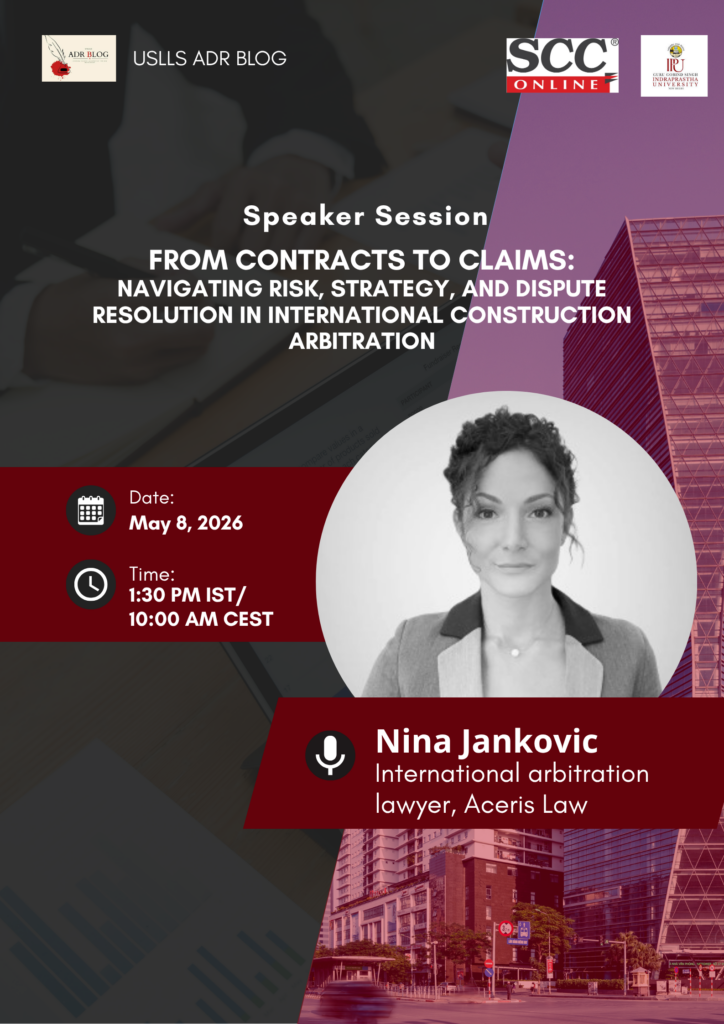 The session was designed for law students and early-career practitioners interested in arbitration and dispute resolution. Its purpose was to connect the contractual foundations of construction projects with the practical realities of arbitral claims. Rather than treating construction arbitration as an abstract procedural subject, the presentation focused on how project decisions, notices, records, expert evidence, and risk allocation shape the outcome of disputes long before a request for arbitration is filed.
A central theme of the session was that construction arbitration is different from ordinary commercial arbitration. International construction projects combine technical, legal, financial, and operational risks. They often involve employers, contractors, subcontractors, suppliers, consultants, financiers, engineers, and insurers, sometimes across several jurisdictions. Disputes may also arise while the works are still ongoing, meaning that legal strategy must be aligned with the need to keep the project moving.
The discussion followed the journey from contract to claim to award. Students were invited to consider the construction contract as the starting point of almost every claim. Clauses dealing with scope, time, price, quality, notices, dispute boards, governing law, and arbitration all operate as risk allocation tools. If these provisions are unclear, inconsistent, or poorly administered, a later claim becomes harder to prove or defend.
Particular attention was given to FIDIC contracts and the different risk profiles of the Red, Yellow, and Silver Books. As explained in Aceris Law’s Construction Arbitration Handbook, the Red Book generally reflects an employer-designed model, the Yellow Book shifts design responsibility to the contractor, and the Silver Book moves further toward contractor risk in exchange for greater price and completion certainty for the employer. The strategic lesson was simple: certainty usually has a price, and pushing more risk onto the contractor may increase both tender prices and the technical complexity of future disputes.
The session then addressed typical claim triggers in international construction arbitration: variations, delay and disruption, defects, errors in the employer’s requirements, payment chains, and back-to-back subcontracting. Delay claims were used as an example of how facts become proof. An extension of time may protect a contractor from liquidated damages, but compensation for prolongation or disruption normally requires separate proof of compensable delay, causation, and loss. The importance of contemporaneous programs, daily records, correspondence, meeting minutes, and expert delay analysis was emphasised throughout.
Liquidated damages and penalty clauses were also discussed as tools for predictability and risk control. The session highlighted the distinction between common law systems, where clauses may be vulnerable if they are punitive or out of proportion to a legitimate commercial interest, and civil law systems, where penalty clauses are generally valid but may be reduced if excessive. This comparative perspective is especially important in international projects where the governing law, seat, place of performance, and parties’ legal traditions may differ.
Another practical focus was dispute avoidance. Construction contracts often provide for an engineer, project manager, dispute adjudication board, dispute avoidance/adjudication board, adjudicator, or senior negotiation step before arbitration. These mechanisms should not be treated as mere formalities. Used well, they can narrow issues, preserve cash flow, and help parties resolve disagreements before they grow into full-scale arbitration.
The final part of the session considered arbitration strategy. Construction cases are usually document-heavy and expert-heavy. A persuasive case requires a clear separation between entitlement, causation, and quantum. Documents establish what happened, witnesses explain the project context, and experts assist tribunals with delay, quantum, engineering, defects, and other technical issues. Site visits, visual schedules, Scott Schedules, and focused document production may also help tribunals understand complex factual records.
The session concluded with five practical tips for students and young practitioners: read the risk allocation before the claim arises; comply with notice and time-bar provisions; keep contemporaneous records and a live claims register; separate entitlement, causation, and quantum; and use dispute boards, negotiation, and arbitration strategically. Aceris Law thanks the USLLS ADR Blog and Ms. Bhoomika Nim for the invitation and excellent organisation of an engaging discussion with students and young practitioners.
For further reading, Aceris Law’s A Practical Handbook on International Construction Arbitration and the Construction Arbitration Handbook PDF collect practical notes on the issues addressed during the session, including managing construction disputes, FIDIC risk allocation, delay claims, and costs of construction arbitration.
