
Choosing SIAC arbitration determines far more than the institution that will administer a dispute. It places the parties within a procedural framework that shapes how the arbitration is commenced, how the tribunal is constituted, how urgent applications are handled, how evidence is presented and, ultimately, how the award is rendered. The 2025 SIAC Arbitration Rules (“SIAC Rules”) give parties and tribunals considerable flexibility within that framework, while introducing new mechanisms designed to make proceedings faster and more proportionate. For a party contemplating arbitration, the important question is therefore not simply what the SIAC Rules provide, but how a SIAC arbitration actually unfolds in practice and what decisions need to be made at each stage.
 The seventh edition of the SIAC Arbitration Rules came into force on 1 January 2025, introducing a number of significant procedural changes. Among other things, the new SIAC Rules establish a Streamlined Procedure, broaden the scope of the Expedited Procedure, introduce mechanisms for Preliminary Determination and Coordinated Proceedings, and enhance the Emergency Arbitrator framework. They also address a range of practical issues more expressly, including the use of tribunal secretaries, third-party funding, information security, mediation and environmentally sustainable procedures.[1] The new procedures have already begun to see significant use. In 2025, SIAC received 886 new cases, 89% of which were international, including 60 cases proceeding under the Streamlined Procedure. It also received 130 applications for the Expedited Procedure, 19 Emergency Arbitrator applications and applications under the newly introduced Preliminary Determination mechanism.[2]
For parties considering or facing SIAC arbitration, the SIAC Rules are only part of the picture. Much of what determines how the case unfolds will depend on choices made along the way: which parties and contracts fall within the arbitration, whether any claims are time-barred, whether urgent or protective relief is needed, how the tribunal should be constituted, what evidence will be required and how damages should be presented. Questions of security, settlement and eventual enforcement may also arise. This practical note follows the SIAC arbitration process chronologically, from the initial review of the contract and arbitration agreement through to the final award and its enforcement.[3]
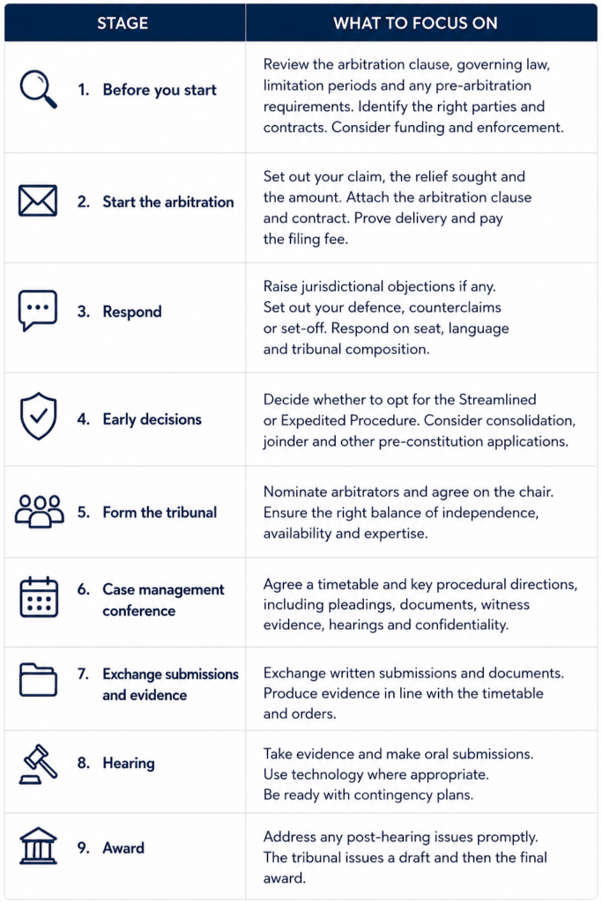
At a Glance: The Main Stages of a SIAC Arbitration
The table below provides an overview of how a SIAC arbitration typically progresses. The timetable will vary from case to case, however, particularly where the tribunal adapts the procedure, the Registrar extends an institutional deadline, or the arbitration proceeds under the Streamlined or Expedited Procedure.[4]
1. Why Parties Choose SIAC Arbitration
SIAC combines institutional oversight with independent decision-making by the arbitral tribunal. The Secretariat handles the day-to-day administration of cases, while the SIAC Court and the President perform the functions assigned to them under the Rules, including certain decisions on jurisdiction, consolidation, arbitrator challenges and appointments. The merits of the dispute, however, are for the tribunal to decide. This structure gives parties the benefit of institutional support and supervision while preserving the tribunal’s role as the independent decision-maker.[5]
Choosing SIAC does not mean that the arbitration must be seated in Singapore or governed by Singapore law. The parties remain free to choose the seat, substantive law and language that best suit their transaction. If they have not agreed on the seat, the tribunal determines it.[6] Hearings may be conducted in person, remotely or in a hybrid format, and they do not have to take place at the legal seat of the arbitration.[7]
The 2025 SIAC Rules are particularly attractive where parties need a range of procedural speeds. A lower-value case may fall within the Streamlined Procedure; a larger or exceptionally urgent case may qualify for the Expedited Procedure; emergency relief is available before the tribunal is constituted; and the tribunal can determine a discrete issue preliminarily or dismiss a manifestly defective claim or defence at an early stage.[8] Related disputes do not necessarily have to proceed separately. Depending on the circumstances, SIAC may allow arbitrations to be consolidated or coordinated, or additional parties to be joined.
Of course, no institutional rules can remove the cost of a genuinely complex dispute. Much will still depend on the size of the case, the number of arbitrators, the volume of documents and evidence, the hearing, and the way the parties choose to conduct the arbitration. The flexibility of the SIAC Rules is most useful when the procedure is shaped around the dispute from the outset.
2. Preparing Before Filing
2.1 Confirm the Arbitration Agreement and the Applicable Rules
Before preparing the claim or defence in detail, the arbitration agreement should be checked carefully. Does it clearly provide for arbitration under the SIAC Rules? A reference to “arbitration in Singapore”, without more, does not necessarily amount to an agreement to SIAC administration. Particular care is needed with clauses that borrow language from different arbitral institutions or contain inconsistent provisions on rules, appointments or court jurisdiction, as these can generate preliminary disputes that consume time and costs before the substance of the case is addressed.[9]
Rule 1.5 provides that the 2025 SIAC Rules generally apply to arbitrations commenced on or after 1 January 2025, unless the parties have agreed otherwise. In practice, this means that a contractual reference to the SIAC Rules will usually be understood as referring to the version in force when the arbitration begins.[10] The arbitration agreement should nevertheless be checked carefully for any express reference to an earlier edition. It is also worth reviewing any amendments, side letters, guarantees, assignments, novations or incorporated terms. The commercial rights may have been transferred or amended over time, and the arbitration agreement may not always have followed them in exactly the same way.
The arbitration clause should also be read alongside any pre-arbitration requirements, such as negotiation, a senior-management meeting, mediation, expert determination, an engineer’s decision or a cooling-off period. Whether those steps are mandatory, and what happens if they are not followed, will depend on the wording of the clause and the applicable law. Particular care is needed where a limitation period is approaching. In a time-sensitive case, it may be necessary to consider commencing the arbitration protectively while completing, or expressly reserving rights in relation to, the agreed pre-arbitration process.[11]
2.2 Choose the Seat for Legal Reasons, Not Convenience
The seat is the legal home of the arbitration. It determines the procedural law governing the proceedings, the courts that exercise supervisory jurisdiction and the place where the award is legally treated as having been made.[12] It should not be confused with the physical venue of a hearing, which may be elsewhere or entirely remote.
Where Singapore is chosen, the International Arbitration Act 1994 and the UNCITRAL Model Law generally provide the legal framework for an international arbitration, including court support, tribunal jurisdiction and the limited grounds for setting aside an award.[13] A different seat may be more appropriate where the dispute, the parties or relevant assets have a closer legal connection to another jurisdiction. Before choosing the seat, consider the local arbitration law, the approach of the courts, rules on arbitrability, the availability of interim relief, confidentiality protections and any implications for enforcement.
The same care should be taken with the substantive law, the law governing the arbitration agreement and the language of the proceedings. Rule 35 gives effect to the parties’ choice of law for the merits, while Rule 37 recognises their choice of language.[14] If no choice has been made on those matters, the tribunal will decide them. The law governing the arbitration agreement may require a separate conflict-of-laws analysis. A clause referring simply to “Singapore law” may therefore leave open exactly what that choice is intended to govern.
2.3 Identify the Right Parties, Contracts and Relief
Complex commercial disputes often involve more than one contract or corporate entity. Before filing, it is useful to map the contractual and corporate relationships involved: each proposed claimant and respondent, the relevant agreements and guarantees, any affiliates, assignments or novations, the arbitration agreements relied upon, and the claims arising under each contract. That exercise can reveal whether a single Notice will suffice, whether separate arbitrations must be commenced, and whether consolidation, coordinated proceedings or joinder may be available.[15] Just as importantly, it helps avoid a more basic problem: bringing the claim against the wrong entity or leaving out a party whose participation may be necessary to obtain effective relief.
The analysis should then turn to what the client actually needs the arbitration to achieve. Damages may be the principal remedy, but money alone may not be enough where there is a risk that assets will be dissipated, confidential information disclosed, goods or evidence lost, or an important contractual relationship disrupted. The strategy should therefore consider the full range of potential relief from the outset, including final and interim measures, emergency relief, declarations, interest and costs. Enforcement should also be considered early: where are the counterparty’s assets, and will the relief ultimately sought be capable of effective recognition and enforcement in those jurisdictions?[16]
2.4 Preserve the Evidence and Prepare the Case for Filing
Evidence should be preserved as soon as a dispute is reasonably anticipated. A proportionate preservation notice should cover the sources most likely to matter, including emails, messaging applications, project files, accounting systems, cloud storage, relevant devices and metadata. Key witnesses should also be identified early, while events are still fresh in their minds. In technically or financially complex cases, there can be real value in involving an expert at an early stage, not to endorse a figure that has already been settled upon, but to test causation, identify weaknesses in the available evidence and help develop a defensible approach to quantum.
The amount claimed also matters from the outset. The Notice of Arbitration and the Response require an initial estimate of the amount of the claim or counterclaim, and that figure can affect both the procedure available and the deposits payable to SIAC. The estimate does not need to be final, but it should have a sensible basis.[17] An early quantum analysis should distinguish, where relevant, between principal amounts, interest, currencies, tax consequences, mitigation and alternative damages scenarios rather than presenting a single headline figure without explanation.
If third-party funding is being considered, it should be addressed before filing where possible. Under the 2025 SIAC Rules, the existence of a funding arrangement and the identity and contact details of the funder must be disclosed in the Notice or Response, or as soon as practicable if the arrangement is entered into later. The obligation is continuing, and the tribunal may require further disclosure, including information about the funder’s interest in the outcome and whether it has agreed to meet any adverse costs liability.[18]
The parties should also establish a secure way of working from the beginning of the case. Rule 61 of the SIAC Rules requires parties and tribunals to consider appropriate information-security measures, and the first case-management conference provides a natural opportunity to agree them formally.[19] Depending on the sensitivity of the dispute, a protocol may address access permissions, electronic data rooms, encryption, approved communication platforms, cross-border data transfers, breach notification, document retention and the protection of confidential information or trade secrets.
3. Commencing the Arbitration: The Notice of Arbitration
A SIAC arbitration formally begins when the Registrar receives the claimant’s Notice of Arbitration. The claimant must deliver the Notice to both the Registrar and the respondent, after which the Secretariat confirms the date of commencement to the parties.[20] Under the 2025 Rules, commencement is therefore tied to the Registrar’s receipt of the Notice, rather than to a determination that the filing is complete, as was more directly the case under the 2016 SIAC Rules. Filing defects are not without consequence, however. The Registrar may require the claimant to correct any deficiencies and, if they are not remedied or the filing fee is not paid, may terminate the arbitration without prejudice.[21]
Rule 6.3 of the SIAC Rules sets out the information that must accompany the Notice of Arbitration. Among other things, the claimant must include a demand that the dispute be referred to arbitration, details of the parties and their representatives, information on how and when the Notice was delivered to the respondent, the arbitration agreement and the contract, treaty or other instrument giving rise to the dispute.[22] The Notice must also describe the dispute and the relief sought, provide an initial estimate of the amount claimed, and address matters such as the applicable law, seat, language, number of arbitrators and constitution of the tribunal. Any required third-party funding disclosure must also be made, and the applicable filing fee paid. The claimant may additionally comment on the possibility of mediation and, if it wishes, submit its Statement of Claim together with the Notice.
The Notice should give the case enough shape to be understood without attempting to argue every issue at the outset. It should give the reader a clear account of the dispute, identify the contractual and legal basis of the claims, explain the relief sought and address any jurisdictional issues that are likely to arise. The SIAC Guide correctly treats the Notice as an advocacy document in its own right: it may be the tribunal’s first introduction to the case, even though the claimant will ordinarily have a later opportunity to set out its case in full. [23] The key documents needed to understand the dispute should be included, but there is little value in overwhelming the filing with material that can be introduced later in an organised way.
Do not treat delivery of the Notice as a formality. Rule 6 of the SIAC Rules requires the claimant to deliver it to both the Registrar and the respondent, while Rule 4 governs written communications and when they are treated as received.[24] SIAC Gateway may also be used in accordance with the Rules and any directions from the Secretariat. Keep a clear record of transmission and receipt, check any addresses specified in the contract, and consider any local service requirements that could become relevant at the enforcement stage.
4. The Response and SIAC’s Early Review
The respondent’s first formal step is the Response, which must be delivered within 14 days of commencement or receipt of the Notice, whichever is later.[25] It should address both substance and procedure: the respondent’s position on the claims, any jurisdictional objections, counterclaims, cross-claims or set-off, and its views on the applicable law, seat, language and constitution of the tribunal. Any required third-party funding disclosure should also be made at this stage.
Because the deadline is short, several workstreams should begin in parallel. The respondent will usually need to preserve evidence, review the arbitration agreement, check limitation periods, identify potential counterclaims and carry out conflict checks for arbitrator candidates. It should also consider whether any pre-constitution application is needed. These early decisions matter because the Response may shape how SIAC and the eventual tribunal first understand the dispute, as well as how the tribunal is constituted and the procedure begins.[26]
A respondent’s failure to file a Response does not prevent SIAC from continuing to administer the arbitration, nor does it entitle the claimant to an automatic default award. The claimant must still establish the tribunal’s jurisdiction and prove its case. A respondent that does not participate, however, risks giving up important opportunities to influence the constitution of the tribunal, the procedural timetable and the evidentiary record.[27]
If a party challenges the existence, validity or applicability of the arbitration agreement, or if the respondent fails to file a Response, the Registrar may refer the matter to the SIAC Court for a prima facie determination of whether, and to what extent, the arbitration should proceed. Any such decision is preliminary: it does not prevent the tribunal, once constituted, from determining its own jurisdiction.[28]
The Registrar may also convene an administrative conference before the tribunal is constituted to address procedural or administrative matters. This can be particularly useful where early applications, questions over the conduct of the proceedings or practical arrangements require attention before the tribunal is in place. [29]
5. Choosing the Right Procedural Track: Standard, Streamlined or Expedited Arbitration
The 2025 SIAC Rules offer different procedural tracks depending on the nature of the dispute. The amount at stake is important, but it is not the only consideration: complexity, urgency and the parties’ agreement can also determine whether a case follows the ordinary procedure or moves onto a faster timetable.
5.1 Streamlined Procedure
The Streamlined Procedure is the fastest of the three routes. It applies where the parties agree to use it before the tribunal is constituted or where the amount in dispute does not exceed S$1 million, unless the President determines, on a party’s application, that the procedure should not apply. The parties may also exclude the Streamlined Procedure by written agreement.[30] For qualifying lower-value disputes, it is therefore the presumptive procedure rather than simply an optional fast track.
The process is deliberately compressed. A sole arbitrator will hear the case, and the parties have three days after the Secretariat notifies them that the Streamlined Procedure applies to nominate that arbitrator jointly.[31] If they cannot agree, or if either party asks SIAC to step in, the President will make the appointment as soon as practicable. The tribunal must then hold its first case-management conference within five days of being constituted.[32]
The procedure is also designed to limit the evidentiary steps that often account for much of the time and cost of an arbitration. Unless the tribunal decides otherwise after hearing the parties’ views, the case will be determined on written submissions and documentary evidence, without document-production requests or fact or expert witness evidence. A hearing is held only if the tribunal considers one necessary or accepts a party’s request for one. Any hearing will ordinarily take place remotely unless an in-person or hybrid format is agreed or considered appropriate.
The final award must be made within three months of the tribunal’s constitution unless the Registrar extends the deadline, and the reasons may be given in summary form. Tribunal and SIAC fees are also generally capped at 50% of the ordinary maximum amounts under the Schedule of Fees, unless the Registrar determines otherwise. Applications for Preliminary Determination under Rule 46 of the SIAC Rules and Early Dismissal under Rule 47 of the SIAC Rules are not available under this procedure.[33]
For a relatively straightforward dispute, these restrictions can produce substantial savings in time and cost. They may be less suitable, however, where the outcome is likely to depend on extensive document production, contested witness evidence or complex expert analysis. A party faced with such a case should consider promptly whether to seek a determination that the Streamlined Procedure should not apply, rather than waiting until the compressed timetable is already underway.
5.2 Expedited Procedure
The Expedited Procedure applies where the parties have agreed to it before the tribunal is constituted. A party may also apply for expedited treatment before constitution where the amount in dispute exceeds S$1 million but does not exceed S$10 million, where a case below S$1 million has been removed from the Streamlined Procedure, or where the circumstances otherwise justify expedition.[34] The President decides whether the procedure will apply after considering the parties’ views.
A sole arbitrator will ordinarily be appointed unless the President determines otherwise. The tribunal has broad discretion to streamline the case, including by deciding it on documents, limiting document production, submissions and witness evidence, or conducting any hearing remotely. The final award must generally be made within six months of constitution, unless the Registrar extends the deadline.[35] Unlike the Streamlined Procedure, expedited proceedings do not automatically dispense with document production or witness evidence. Instead, the tribunal has flexibility to limit those steps where appropriate.
5.3 Standard Procedure and the Strategic Choice
If neither the Streamlined nor the Expedited Procedure applies, the arbitration proceeds under the ordinary SIAC Rules. That does not mean the process must be lengthy. Rule 32 of the SIAC Rules gives the tribunal broad flexibility to sequence or bifurcate issues, limit submissions and evidence, and focus the parties on potentially dispositive questions. Preliminary Determination and Early Dismissal may also help resolve suitable issues early. [36]
The right procedure depends on the case. A straightforward payment dispute may be decided largely on documents, while a technically complex construction case may require fuller evidence and hearings. The objective is not simply speed, but a process proportionate to the dispute.[37]
6. Emergency Relief Before the Tribunal Is Constituted
A party that cannot wait for the tribunal to be constituted may apply for the appointment of an Emergency Arbitrator under Rule 12 and Schedule 1 of the SIAC Rules. The application may be made before, together with or after the Notice of Arbitration, provided the tribunal has not yet been constituted. If the application is filed first, the Notice must follow within seven days unless the Registrar extends the time.[38]
The application must set out the basis of the dispute, the emergency relief sought and the reasons why the relief cannot await constitution of the tribunal. It must also provide the required information on the parties, arbitration agreement, applicable law, seat, language and any third-party funding, together with the applicable fee and deposit. If SIAC accepts the application, the President will seek to appoint the Emergency Arbitrator within 24 hours after receipt of the complete application and payment. The Emergency Arbitrator must establish a procedural schedule within 24 hours of appointment and issue an order or award within 14 days, unless the Registrar extends the deadline.[39]
The 2025 SIAC Rules also introduce a protective preliminary order mechanism for exceptional cases where giving advance notice could frustrate the relief sought. Unless the parties have agreed otherwise, the applicant may seek appointment of an Emergency Arbitrator without first notifying the opposing party. The protective application must be decided within 24 hours of appointment. If an order is made, SIAC transmits it to all parties and the applicant must promptly provide the opposing party with the case papers and communications.[40] The mechanism is intended to preserve the effectiveness of urgent relief, rather than determine the dispute without giving the other party an opportunity to be heard.
Court relief also remains available. Seeking interim measures from a competent court does not conflict with the SIAC Rules, although the Registrar and tribunal should be notified promptly.[41] Whether court relief or the Emergency Arbitrator procedure is the better route will depend on the circumstances, including the urgency of the application, where the relief must take effect, how readily it can be enforced and whether orders are needed against a third party.
7. Managing Multi-Contract and Multi-Party Disputes
Where a dispute involves more than one arbitration agreement, Rule 15 of the SIAC Rules gives the claimant several filing options. It may file separate Notices, file separate Notices together with an application for consolidation, or file a single Notice covering all of the arbitration agreements, which will itself be treated as a consolidation application. Until consolidation is granted, however, each arbitration agreement is treated as giving rise to a separate arbitration.[42]
Related arbitrations may be consolidated into a single proceeding in appropriate circumstances. Before any tribunal is constituted, the SIAC Court may grant consolidation where all parties agree, where the claims arise under the same arbitration agreement, or where compatible arbitration agreements concern sufficiently connected contracts, legal relationships or transactions.[43] Consolidation can also be sought after constitution, although additional requirements then apply, particularly concerning the tribunals already appointed.
The 2025 SIAC Rules also introduce Coordinated Proceedings. Where the same tribunal is hearing two or more arbitrations that share a common issue of law or fact, the proceedings may be run concurrently or sequentially, heard together with aligned procedures, or one case may be suspended pending a decision in another. Unlike consolidation, the arbitrations remain separate and, unless the parties agree otherwise, result in separate decisions and awards.[44] Coordination can therefore reduce duplication without merging the underlying cases.
Joinder provides another option where an additional party needs to be brought into an existing arbitration. Before or after constitution of the tribunal, joinder may be permitted where all parties, including the proposed additional party, agree, or where that party is prima facie bound by the arbitration agreement. Any decision on joinder remains without prejudice to the tribunal’s ultimate decision on jurisdiction.[45] In a complex case, it is often helpful to map the relevant contracts, arbitration agreements, parties and claims before deciding which of these mechanisms is appropriate.
8. Constituting the Tribunal
Choosing the tribunal is one of the most important decisions in the arbitration. Under Rule 19 of the SIAC Rules, the tribunal will consist of either one or three arbitrators. If the parties have not agreed on the number, a sole arbitrator is the default unless the Registrar considers that the complexity, value or other circumstances of the case justify three.[46] A sole arbitrator will often be more economical and easier to schedule, while a three-member tribunal may bring a wider range of legal, linguistic, technical or regional experience.
The appointment process depends on whether the tribunal consists of one or three arbitrators. For a sole arbitrator, the parties usually have 21 days to agree on a joint nomination, failing which the President appoints the arbitrator. For a three-member tribunal, the claimant nominates first, within 14 days of commencement, and the respondent then has 14 days from receipt of that nomination to nominate its arbitrator. The President appoints the presiding arbitrator unless the parties have agreed otherwise.[47] Multi-party cases are subject to separate joint-nomination rules, and every nomination must ultimately be confirmed by the President.
Arbitrator selection should look beyond subject-matter expertise. Independence, availability, relevant experience, case-management ability and the capacity to produce a well-reasoned and enforceable award all matter. Industry knowledge may be helpful, but strong legal and procedural judgment is usually more important. It is also worth checking whether the arbitrator can realistically accommodate the expected hearing and award timetable.
Prospective arbitrators must disclose any circumstances that could give rise to justifiable doubts about their independence or impartiality, and that duty continues after appointment.[48] Rule 25 of the SIAC Rules allows limited contact with a prospective arbitrator before the tribunal is constituted, including to discuss the general nature of the dispute and the candidate’s qualifications, availability and independence. Those discussions must remain within the permitted limits, and there may be no ex parte communication with a candidate for presiding arbitrator. [49]
An arbitrator may be challenged where there are justifiable doubts about their independence or impartiality, where they lack qualifications agreed by the parties, or where they are unable to perform their functions. A challenge must generally be filed within 15 days of receiving notice of the appointment or within 15 days after the relevant circumstances became known, or should reasonably have become known, to the challenging party.[50] If the challenge is not otherwise resolved, the SIAC Court will decide it by a reasoned decision, which is final under the Rules.
The tribunal may appoint a secretary after considering the parties’ views and consulting the Registrar. A tribunal secretary may assist with the conduct and administration of the case, but the tribunal cannot delegate any decision-making function to them. Any challenge must generally be made within seven days of the appointment or of the relevant circumstances becoming known.[51] The secretary’s role, confidentiality obligations, time commitment and fees should be clear from the outset.
9. The First Case-Management Conference and Procedural Order No. 1
Soon after the tribunal is constituted, it will hold a first case-management conference to agree how the arbitration should proceed.[52] This is an important stage in the case, as many of the procedural choices made here will shape the timetable, cost and scope of the proceedings.
The parties should be ready to discuss the main procedural steps, including the pleading schedule, any bifurcation of jurisdiction, liability or quantum, document production, witness and expert evidence, confidentiality and privilege, translations, and the timing and format of the hearing. Rule 32 of the SIAC Rules also allows the tribunal to impose page limits, exclude repetitive or irrelevant evidence and focus the proceedings on issues that may dispose of all or part of the case.[53]
A well-drafted Procedural Order No. 1 should also deal with the practical details of running the case, including communications, file and exhibit numbering, hearing bundles, time zones, holidays, extension requests and late filings. It should also make clear that the legal seat is distinct from the hearing venue and address whether case-management conferences may be held remotely.
The tribunal may also discuss with the parties whether there is scope for settlement, including through mediation under the SIAC-SIMC Arb-Med-Arb Protocol, and whether environmentally sustainable procedures would be appropriate.[54] If mediation is worth exploring, it can be built into the procedural timetable without bringing the arbitration to an end. Sustainability measures can also be practical, such as using electronic bundles, holding procedural conferences remotely and limiting unnecessary travel.
Information security should also be addressed in the procedural order. Rule 61 of the SIAC Rules allows the tribunal to put appropriate safeguards in place and to take action where those measures are not followed.[55] Any protocol should reflect the sensitivity of the dispute and the data-protection and professional obligations that apply.
10. Written Submissions, Documents, Witnesses, Experts and Damages
Rule 33 of the SIAC Rules governs the main written submissions. If it has not already been filed, the Statement of Claim sets out the facts, legal basis and relief sought, while the Statement of Defence responds to those claims and sets out any counterclaim, cross-claim or set-off.[56] The parties will usually submit the documents on which they rely with their pleadings, and the tribunal may also set a timetable for witness statements and expert reports.
The tribunal decides what evidence is admissible, relevant and material, and how much weight to give it.[57] In practice, that flexibility makes careful preparation no less important. The evidence should support each part of the case, from the underlying facts and legal claims through to causation, quantum and the relief sought.
Document production in SIAC arbitration is usually narrower than discovery in court proceedings. The tribunal may order a party to produce documents in its possession or control where they are relevant and material to the dispute.[58] Requests are often exchanged in a schedule setting out each request, the response or objection, and the tribunal’s ruling, although the Rules do not require any particular format. The IBA Rules on the Taking of Evidence in International Arbitration are also commonly used as guidance when structuring document-production requests and objections.[59]
Requests should be focused on specific documents or reasonably narrow categories and explain why the material matters to the case. Objections based on privilege, confidentiality, burden or proportionality should likewise be stated clearly and with sufficient detail.[60]
Party-appointed experts should be given clear instructions and the material they need to form their own independent views. The tribunal may also appoint an expert of its own after consulting the parties on the expert’s role and fees. The parties must be given the opportunity to comment on the expert’s report and, where appropriate, question the expert.[61]
A damages case is usually strongest when the calculation is easy to follow. The claimant should make clear what would have happened but for the breach, how the loss was caused, the relevant valuation date and the assumptions used for matters such as mitigation, currency, discount rate, interest and tax. The respondent should test those elements individually, rather than simply putting forward a lower figure. If it would save time and cost, the tribunal can also separate liability from quantum and deal with damages in a later phase.[62]
Documents submitted in a language other than the language of the arbitration may need to be translated in the form directed by the Registrar or tribunal. It is worth agreeing early whether full or partial translations are required, whether they must be certified and how any disputed translations will be dealt with. Pleadings, evidence and other materials submitted in the arbitration are also covered by the confidentiality obligations in Rule 59 of the SIAC Rules.[63]
11. Jurisdiction, Preliminary Determination and Early Dismissal
The tribunal has the power to decide its own jurisdiction, including objections to the existence, validity, applicability or scope of the arbitration agreement. The arbitration agreement is treated as separate from the underlying contract, so the invalidity of the contract does not automatically invalidate the agreement to arbitrate.[64] A jurisdictional objection must generally be raised no later than the Statement of Defence. If the objection is that the tribunal has gone beyond the scope of its authority, it must normally be raised within 15 days of the relevant issue arising.[65]
Rule 46 of the SIAC Rules allows a party to seek an early determination of a discrete issue where the parties agree, where doing so is likely to save time and cost, or where the circumstances otherwise justify it.[66] If the tribunal allows the application to proceed, it must make its decision within 90 days of the application unless the Registrar extends the time. Unlike Early Dismissal, there is no requirement that the issue be “manifestly” defective. The point is to resolve an issue early where doing so may simplify the rest of the case.
Early Dismissal under Rule 47 has a higher threshold. It is available only where a claim or defence is manifestly without legal merit or manifestly outside the tribunal’s jurisdiction.[67] If the application is allowed to proceed, the tribunal must decide it within 45 days unless the Registrar extends the deadline.
Both mechanisms can save significant time and cost, but only where the issue can genuinely narrow or dispose of part of the case. An application that does not meet that test may simply add another procedural step. In 2025, SIAC received four Preliminary Determination applications, three of which were allowed to proceed; two had been granted by the end of the year.[68]
12. Preparing for and Conducting the Hearing
Unless the parties have agreed to a documents-only process, the tribunal must hold a hearing if either party requests one or if the tribunal considers one necessary.[69] After consulting the parties, the tribunal decides the timing and format, and the hearing may take place in person, remotely or in hybrid form.
A pre-hearing conference should resolve the daily schedule, opening submissions, witness order, expert conferencing, time allocation, interpretation, transcript, demonstratives, objections, sequestration, confidentiality, technology and the final hearing bundle.[70] It should also address what happens if a witness, connection or platform fails.
Witness examination should focus on the issues that are genuinely disputed. Rule 40 of the SIAC Rules gives the tribunal flexibility over how witnesses are examined, including the use of remote testimony and limits on oral evidence.[71] Expert conferencing may also be useful where the main disagreement concerns methodology rather than underlying facts.
Hearings are private unless the parties agree otherwise, and the confidentiality obligations in Rule 59 continue to apply.[72] The hearing protocol should therefore make clear who may attend and how particularly sensitive evidence will be handled.
13. Interim Relief, Security and Non-Participation
Once constituted, the tribunal may grant interim or conservatory relief and may require the applicant to provide security. A party may also seek interim relief from a competent court without waiving the arbitration agreement, although the tribunal and Registrar must be notified promptly.[73]
Rules 48 and 49 deal separately with security for costs and security for claims. A party pursuing a claim may be ordered to provide security for costs, while a party defending a claim may be ordered to provide security against the claim itself.[74] These applications should be based on the circumstances of the case rather than treated as an automatic consequence of financial difficulty or third-party funding.
A party’s refusal to participate does not stop the arbitration. The tribunal may continue on the evidence before it and may impose appropriate sanctions for failure to comply with the Rules or its directions.[75] Importantly, non-participation is not treated as an admission, so the participating party must still prove its case and provide the tribunal with a proper basis for its award.
14. Closure, the Award and SIAC Scrutiny
Once the parties have completed their submissions and the tribunal is satisfied that no further relevant evidence or argument is needed, it will declare the proceedings closed.[76] The tribunal may reopen them before an award is made if necessary. Before closure, counsel should check that all relief sought, including interest and costs, has been addressed.
The tribunal may issue more than one award during the arbitration. Awards must be in writing, signed and reasoned, although consent awards need not give reasons. They may also be signed electronically or in counterparts. In a three-member tribunal, decisions are made by majority; if there is no majority, the presiding arbitrator decides.[77]
Before an award is issued, the tribunal must submit a draft to SIAC for scrutiny. The Registrar may suggest changes to its form and draw attention to substantive points, while leaving the tribunal’s decision-making authority intact.[78] No award may be issued until the Registrar approves its form. The tribunal must also provide a timing estimate within 30 days of the last directed submission and generally submit the draft award within 90 days, unless the Registrar determines otherwise.[79]
The tribunal may award simple or compound interest on sums and costs. Parties should therefore specify the legal basis, rate, period and any proposed compounding rather than leave interest to the end of the case.[80]
15. Costs and Deposits
SIAC’s administrative and arbitrator fees are generally calculated by reference to the amount in dispute. The 2025 Schedule of Fees also provides for a non-refundable filing fee of S$3,000 for overseas parties and S$3,270, including GST, for Singapore parties.[81]
The Registrar fixes deposits towards the estimated costs of the arbitration, normally split equally between claimant and respondent, although separate deposits may be required for claims, counterclaims or cross-claims.[82] The amount can be adjusted as the case develops, and if one party does not pay its share, the other may be asked to do so.
Failure to pay can lead to suspension of the proceedings or, ultimately, the relevant claim being treated as withdrawn without prejudice. A party that pays the other side’s share may ask the tribunal to order reimbursement.[83]
At the end of the case, the Registrar determines the costs of the arbitration, while the tribunal decides how those costs, together with the parties’ reasonable legal and other costs, should be allocated.[84]
16. After the Award: Corrections, Challenge and Enforcement
Within 30 days of receiving the award, a party may ask the tribunal to correct clerical or computational errors, interpret a specific part of the award, or make an additional award on a claim that was presented but not decided.[85] These procedures are limited in scope and do not provide an opportunity to reargue the merits.
SIAC awards are final and binding, subject to any rights of challenge that cannot validly be waived.[86] Any application to set aside an award is governed by the law of the seat. For Singapore-seated international arbitrations, the principal grounds are found in Article 34 of the Model Law and section 24 of the International Arbitration Act.[87] Challenge deadlines are strict, so advice should be taken promptly.
Enforcement should also be considered before the award is issued. The New York Convention provides the main framework for recognising and enforcing international arbitral awards, subject to limited grounds for refusal.[88] A successful party should identify relevant assets and enforcement jurisdictions early, together with any translation, authentication or local filing requirements.
The record created during the arbitration can be important at this stage. Rule 64 of the SIAC Rules provides that a party may lose the right to object to known procedural non-compliance if it does not raise the issue within the applicable deadline or, where none is stated, within 15 days.[89]
17. Confidentiality, Publication and Information Security
Rule 59 of the SIAC Rules imposes a continuing duty of confidentiality covering the existence of the arbitration, pleadings, evidence, submissions, communications, decisions and awards.[90] There are specific exceptions, including disclosures required by law or regulators and those needed for court proceedings, enforcement or the protection of legal rights. Clients should therefore consider early how the arbitration’s confidentiality requirements interact with reporting obligations to boards, auditors, insurers and regulators.
The tribunal may enforce confidentiality obligations, protect trade secrets and impose sanctions, damages or costs for breach.[91] SIAC itself may publish a decision, ruling, order or award only with the written agreement of all parties and after removing identifying information.
Rule 61 separately addresses information security. The parties may agree appropriate safeguards, and the tribunal can give directions on cybersecurity and other protective measures, including at the first case-management conference.[92] SIAC retains its case archive for at least six years after the final award or termination, so parties should maintain their own records for any longer-term enforcement or regulatory needs.[93]
Conclusion
SIAC’s 2025 Arbitration Rules give parties a wide range of procedural tools, but no case will need all of them. The key is to choose the procedures that fit the dispute. For claimants, that starts with identifying the right parties, contracts, relief and evidence. Respondents need to use the short Response period to protect jurisdictional objections, counterclaims and procedural options. For both sides, tribunal selection and the first case-management conference can have a significant influence on how the arbitration develops.
The Rules are most effective when the case is prepared carefully from the outset and the procedure remains proportionate to what is actually in dispute. Clear drafting, preserved evidence, a realistic approach to quantum, the right tribunal and sensible procedural choices can help keep the arbitration focused and move it efficiently towards an enforceable award.
[1] 2025 SIAC Arbitration Rules, Rules 11-18, 24, 32.4, 38, 46-47 and 61 and Schedules 1-3; B. Hanotiau, The New SIAC Arbitration Rules 2025: Modernity, Efficiency, Transparency, 43(1) ASA Bull. 34, pp. 34-45; Aceris Law LLC, The Revised 2025 SIAC Arbitration Rules (21 December 2024).
[2] SIAC, Annual Report 2025, pp. 4, 24-25 and 34-39. SIAC reported 886 new cases, including 737 administered cases and 149 ad hoc appointments; its procedural-application statistics are stated as at 31 December 2025.
[3] 2025 SIAC Arbitration Rules, Rule 1.5; J. Choong et al., A Guide to the SIAC Arbitration Rules (2nd ed., 2018), Preface & Acknowledgements and Chapters 3-16 (“SIAC Guide”). The Guide is an independent commentary on the 2016 SIAC Rules and does not comment on the SIAC Rules 2025. References in this article to current rule numbers and deadlines are to the SIAC Rules 2025.
[4] 2025 SIAC Arbitration Rules, Rules 3.5, 5.3 and 32 and Schedules 1-3; SIAC Guide, Chapter 9, pp. 161-188, ¶¶ 9.01-9.10.
[5] SIAC Guide, Chapter 4, pp. 71-77, ¶¶ 4.01-4.26; 2025 SIAC Arbitration Rules, Rules 2, 19, 28, 51, 53, 57 and 63.
[6] 2025 SIAC Arbitration Rules, Rule 36.1; SIAC Guide, Chapter 9, pp. 161-188, ¶¶ 9.43-9.57.
[7] 2025 SIAC Arbitration Rules, Rule 39.2.
[8] 2025 SIAC Arbitration Rules, Rules 12-14, 46-47 and Schedules 1-3; Hanotiau, The New SIAC Arbitration Rules 2025, pp. 34-45.
[9] 2025 SIAC Arbitration Rules, Rule 1.1; SIAC Guide, Chapter 5, pp. 78-98, ¶¶ 5.07-5.17 (discussion of uncertain or “pathological” clauses).
[10] 2025 SIAC Arbitration Rules, Rule 1.5; SIAC Guide, Chapter 5, pp. 78-98, ¶¶ 5.03-5.06; AQZ v ARA [2015] SGHC 49 at [125]-[127].
[11] 2025 SIAC Arbitration Rules, Rules 5 and 6; International Arbitration Act 1994 (Singapore) (“IAA”), s. 8A; SIAC Guide, Chapter 5, pp. 78-98, ¶¶ 5.38-5.44. The effect of a pre-arbitration condition and any limitation period depends on the contract and applicable law.
[12] 2025 SIAC Arbitration Rules, Rules 2.1 (definition of “seat”), 36.1 and 39.2; SIAC Guide, Chapter 9, pp. 161-188, ¶¶ 9.43-9.57.
[13] IAA, ss. 3, 10, 12, 12A and 24 and First Schedule, Arts. 5, 16, 17 and 34; SIAC Guide, Chapter 2, pp. 18-52, ¶¶ 2.01-2.114.
[14] 2025 SIAC Arbitration Rules, Rules 35 and 37; SIAC Guide, Chapter 9, pp. 161-188, ¶¶ 9.58-9.75.
[15] 2025 SIAC Arbitration Rules, Rules 15-18; SIAC Guide, Chapter 7, pp. 110-129, ¶¶ 7.01-7.06; S.I. Strong, Practical Insights on Large-scale (Class, Mass and Collective) Arbitration – Singapore International Arbitration Centre (SIAC), Practical Insights on Arbitral Procedure (last reviewed June 2026).
[16] 2025 SIAC Arbitration Rules, Rules 45, 48-51; Convention on the Recognition and Enforcement of Foreign Arbitral Awards, 10 June 1958 (“New York Convention”), Arts. III-V; SIAC Guide, Chapters 13-14, pp. 236-271.
[17] 2025 SIAC Arbitration Rules, Rules 6.3(f), 7.1(e), 13.1(b), 14.2 and 56.1-56.2; S. Vicente Mazzuz et al., Practical Insights on Damages and Valuation – Singapore International Arbitration Centre (SIAC), Practical Insights on Arbitral Procedure.
[18] 2025 SIAC Arbitration Rules, Rules 6.3(h), 7.1(g) and 38; A. Roberts, Practical Insights on Third-Party Funding – Singapore International Arbitration Centre (SIAC), Practical Insights on Arbitral Procedure (last reviewed December 2025).
[19] 2025 SIAC Arbitration Rules, Rules 32.4 and 61; D. Prokić, Practical Insights on Documentary Evidence and Hearing Bundles – Singapore International Arbitration Centre (SIAC), Practical Insights on Arbitral Procedure (last reviewed July 2026).
[20] 2025 SIAC Arbitration Rules, Rules 6.1-6.2; SIAC Guide, Chapter 5, pp. 78-98, ¶¶ 5.45-5.46 and 5.71-5.75.
[21] 2025 SIAC Arbitration Rules, Rules 6.5-6.6. Compare SIAC Guide, Chapter 5, pp. 78-98, ¶¶ 5.71-5.74, describing the completeness regime under the 2016 SIAC Rules.
[22] 2025 SIAC Arbitration Rules, Rule 6.3; SIAC Guide, Chapter 5, pp. 78-98, ¶¶ 5.45-5.68.
[23] SIAC Guide, Chapter 5, pp. 78-98, ¶¶ 5.46 and 5.56-5.58; 2025 SIAC Arbitration Rules, Rule 6.3(f).
[24] 2025 SIAC Arbitration Rules, Rules 4 and 6.1-6.3(c); SIAC Guide, Chapter 5, pp. 78-98, ¶¶ 5.25-5.44 and 5.75.
[25] 2025 SIAC Arbitration Rules, Rule 7.1; SIAC Guide, Chapter 5, pp. 78-98, ¶¶ 5.76-5.77.
[26] 2025 SIAC Arbitration Rules, Rule 7.1; SIAC Guide, Chapter 5, pp. 78-98, ¶¶ 5.80-5.90.
[27] 2025 SIAC Arbitration Rules, Rule 7.4; SIAC Guide, Chapter 5, pp. 78-98, ¶¶ 5.78-5.79; see also 2025 SIAC Arbitration Rules, Rule 44.
[28] 2025 SIAC Arbitration Rules, Rule 8; SIAC Guide, Chapter 10, pp. 189-201, ¶¶ 10.01-10.09.
[29] 2025 SIAC Arbitration Rules, Rule 11; Hanotiau, pp. 36-37.
[30] 2025 SIAC Arbitration Rules, Rule 13 and Schedule 2, ¶¶ 1-21; Hanotiau, pp. 37-39.
[31] 2025 SIAC Arbitration Rules, Schedule 2, ¶¶ 1-10.
[32] 2025 SIAC Arbitration Rules, Schedule 2, ¶¶ 11-12; Prokić, Practical Insights on Documentary Evidence and Hearing Bundles.
[33] 2025 SIAC Arbitration Rules, Schedule 2, ¶¶ 13-18; SIAC Schedule of Fees (effective 1 January 2025).
[34] 2025 SIAC Arbitration Rules, Rule 14.1-14.4; Hanotiau, pp. 39-40. The monetary ceiling increased from S$6 million under the 2016 SIAC Rules to S$10 million under the 2025 Rules.
[35] 2025 SIAC Arbitration Rules, Schedule 3, ¶¶ 1-10; SIAC Guide, Chapter 6, pp. 99-109, ¶¶ 6.01-6.44 (practical analysis of expedited proceedings under the predecessor Rules).
[36] 2025 SIAC Arbitration Rules, Rules 3.5 and 32.1-32.8; SIAC Guide, Chapter 9, pp. 161-188, ¶¶ 9.01-9.42; K.M. Rooney, Practical Insights on Express, Implied and Inherent Powers of Arbitrators – Singapore International Arbitration Centre (SIAC), in Practical Insights on Arbitral Procedure (last reviewed December 2025).
[37] SIAC, Annual Report 2025, pp. 24-25 and 34-39 (60 Streamlined cases; 130 Expedited Procedure requests, 55 accepted).
[38] 2025 SIAC Arbitration Rules, Rule 12 and Schedule 1, ¶¶ 1-6; SIAC Guide, Chapter 13, pp. 236-255, ¶¶ 13.01-13.17 (emergency and interim relief under the predecessor Rules).
[39] 2025 SIAC Arbitration Rules, Schedule 1, ¶¶ 7-24; Hanotiau, pp. 35-36.
[40] 2025 SIAC Arbitration Rules, Schedule 1, ¶¶ 25-34; Hanotiau, pp. 35-36.
[41] 2025 SIAC Arbitration Rules, Rule 45.2; IAA, s. 12A; SIAC Guide, Chapter 13, pp. 236-255, ¶¶ 13.18-13.44.
[42] 2025 SIAC Arbitration Rules, Rule 15; SIAC Guide, Chapter 7, pp. 110-129, ¶¶ 7.01-7.17.
[43] 2025 SIAC Arbitration Rules, Rule 16.1-16.10; SIAC Guide, Chapter 7, pp. 110-129, ¶¶ 7.41-7.68.
[44] 2025 SIAC Arbitration Rules, Rule 17; Hanotiau, pp. 40-41.
[45] 2025 SIAC Arbitration Rules, Rule 18; SIAC Guide, Chapter 7, pp. 110-129, ¶¶ 7.18-7.40.
[46] 2025 SIAC Arbitration Rules, Rule 19.1-19.2; SIAC Guide, Chapter 8, pp. 130-160, ¶¶ 8.01-8.06.
[47] 2025 SIAC Arbitration Rules, Rules 21-23; SIAC Guide, Chapter 8, pp. 130-160, ¶¶ 8.18-8.53.
[48] 2025 SIAC Arbitration Rules, Rule 20; SIAC Guide, Chapter 8, pp. 130-160, ¶¶ 8.54-8.77.
[49] 2025 SIAC Arbitration Rules, Rule 25; SIAC Guide, Chapter 5, pp. 78-98, ¶ 5.65 and Chapter 8, pp. 130-160, ¶¶ 8.18-8.27.
[50] 2025 SIAC Arbitration Rules, Rules 26-28; SIAC Guide, Chapter 8, pp. 130-160, ¶¶ 8.78-8.115.
[51] 2025 SIAC Arbitration Rules, Rule 24; Rooney, Practical Insights on Express, Implied and Inherent Powers of Arbitrators.
[52] 2025 SIAC Arbitration Rules, Rule 32.4-32.5; J. Walker and D.S. Jones, Practical Insights on Pre-hearing Conference – Singapore International Arbitration Centre (SIAC), Practical Insights on Arbitral Procedure (last reviewed January 2026); SIAC Guide, Chapter 9, pp. 161-188, ¶¶ 9.01-9.10.
[53] 2025 SIAC Arbitration Rules, Rule 32.6-32.8; SIAC Guide, Chapter 9, pp. 161-188, ¶¶ 9.03-9.15.
[54] 2025 SIAC Arbitration Rules, Rule 32.4(a)-(b); SIAC-SIMC Arb-Med-Arb Protocol (effective 1 January 2025); Hanotiau, pp. 43-44.
[55] 2025 SIAC Arbitration Rules, Rule 61; Prokić, Practical Insights on Documentary Evidence and Hearing Bundles.
[56] 2025 SIAC Arbitration Rules, Rule 33; SIAC Guide, Chapter 9, pp. 161-188, ¶¶ 9.33-9.42.
[57] 2025 SIAC Arbitration Rules, Rule 32.3; SIAC Guide, Chapter 9, pp. 161-188, ¶¶ 9.03-9.10; Prokić, Practical Insights on Documentary Evidence and Hearing Bundles.
[58] 2025 SIAC Arbitration Rules, Rule 50.2(f); SIAC Guide, Chapter 12, pp. 214-235, ¶¶ 12.19-12.22.
[59] IBA Rules on the Taking of Evidence in International Arbitration (2020), Arts. 3.3 and 9.2; SIAC Guide, Chapter 12, pp. 214-235, ¶¶ 12.19–12.22.
[60] 2025 SIAC Arbitration Rules, Rule 50.2(f); IBA Rules on the Taking of Evidence in International Arbitration (2020), Arts. 3.3 and 9.2; SIAC Guide, ¶¶ 12.19-12.22.
[61] 2025 SIAC Arbitration Rules, Rule 41; SIAC Guide, Chapter 9, pp. 161-188, ¶¶ 9.107-9.118.
[62] S. Vicente Mazzuz et al., Practical Insights on Damages and Valuation – Singapore International Arbitration Centre (SIAC), Practical Insights on Arbitral Procedure (last reviewed August 2025); SIAC Guide, ¶¶ 14.26-14.33.
[63] 2025 SIAC Arbitration Rules, Rules 37.2, 59.1 and 59.4; K. Chung, Practical Insights on Confidentiality – Singapore International Arbitration Centre (SIAC), Practical Insights on Arbitral Procedure (last reviewed October 2025).
[64] 2025 SIAC Arbitration Rules, Rule 31.1; SIAC Guide, Chapter 10, pp. 189-201, ¶¶ 10.01 and 10.10-10.25; IAA, First Schedule, Art. 16.
[65] 2025 SIAC Arbitration Rules, Rule 31.2-31.4; SIAC Guide, Chapter 10, pp. 189-201, ¶¶ 10.40-10.53.
[66] 2025 SIAC Arbitration Rules, Rule 46; Hanotiau, pp. 41-42.
[67] 2025 SIAC Arbitration Rules, Rule 47; SIAC Guide, Chapter 11, pp. 202-213, ¶¶ 11.01-11.23.
[68] SIAC, Annual Report 2025, pp. 24-25 and 36 (four Preliminary Determination requests; three allowed to proceed; two granted as at 31 December 2025).
[69] 2025 SIAC Arbitration Rules, Rule 39.1-39.2 and Schedules 2-3; SIAC Guide, Chapter 9, pp. 161-188, ¶¶ 9.76-9.82.
[70] 2025 SIAC Arbitration Rules, Rules 32.4-32.6 and 39-40; Walker and Jones, Practical Insights on Pre-hearing Conference.
[71] 2025 SIAC Arbitration Rules, Rule 40.1-40.4; SIAC Guide, Chapter 9, pp. 161-188, ¶¶ 9.83-9.106.
[72] 2025 SIAC Arbitration Rules, Rules 39.3 and 59; Chung, Practical Insights on Confidentiality.
[73] 2025 SIAC Arbitration Rules, Rule 45; SIAC Guide, Chapter 13, pp. 236-255, ¶¶ 13.01-13.44; IAA, ss. 12 and 12A.
[74] 2025 SIAC Arbitration Rules, Rules 48-49; SIAC Guide, Chapter 12, pp. 214-235, ¶¶ 12.29-12.45.
[75] 2025 SIAC Arbitration Rules, Rule 44; SIAC Guide, Chapter 9, pp. 161-188, ¶¶ 9.102-9.104.
[76] 2025 SIAC Arbitration Rules, Rule 42; SIAC Guide, Chapter 14, pp. 256-271, ¶¶ 14.09-14.11.
[77] 2025 SIAC Arbitration Rules, Rules 51.1-51.3, 52; SIAC Guide, Chapter 14, pp. 256-271, ¶¶ 14.26-14.33.
[78] 2025 SIAC Arbitration Rules, Rule 53; SIAC Guide, Chapter 14, pp. 256-271, ¶¶ 14.14-14.21.
[79] 2025 SIAC Arbitration Rules, Rules 53.1-53.2.
[80] 2025 SIAC Arbitration Rules, Rule 51.5; SIAC Guide, Chapter 14, pp. 256-271, ¶¶ 14.36-14.38.
[81] 2025 SIAC Arbitration Rules, Rule 6.3(i); SIAC, Schedule of Fees (effective 1 January 2025), pp. 78-84; SIAC Guide, Chapter 15, pp. 272-292, ¶¶ 15.12-15.39; Aceris Law LLC, Total SIAC Arbitration Costs.
[82] 2025 SIAC Arbitration Rules, Rules 56.1-56.4; SIAC Guide, Chapter 15, pp. 272-292, ¶¶ 15.33-15.50.
[83] 2025 SIAC Arbitration Rules, Rule 56.5-56.7; SIAC Guide, Chapter 12, pp. 214-235, ¶¶ 12.23-12.24 and Chapter 15, pp. 272-292, ¶¶ 15.40-15.57.
[84] 2025 SIAC Arbitration Rules, Rules 57-58; SIAC Guide, Chapter 15, pp. 272-292, ¶¶ 15.64-15.69.
[85] 2025 SIAC Arbitration Rules, Rule 54; SIAC Guide, Chapter 14, pp. 256–271, ¶¶ 14.55–14.76.
[86] 2025 SIAC Arbitration Rules, Rules 51.6–51.7; SIAC Guide, Chapter 14, pp. 256–271, ¶¶ 14.42-14.49.
[87] IAA, s. 24 and First Schedule, Art. 34; SIAC Guide, Chapter 2, pp. 18–52, ¶¶ 2.92-2.114.
[88] New York Convention, Arts. III–V; IAA, ss. 19 and 27–31 and Second Schedule; SIAC Guide, Chapter 2, pp. 18-52, ¶¶ 2.70-2.91
[89] 2025 SIAC Arbitration Rules, Rule 64; SIAC Guide, Chapter 16, pp. 293–307, ¶¶ 16.48–16.51.
[90] 2025 SIAC Arbitration Rules, Rule 59.1-59.4; Chung, Practical Insights on Confidentiality; SIAC Guide, Chapter 16, pp. 293-307, ¶¶ 16.12-16.36.
[91] 2025 SIAC Arbitration Rules, Rules 59.5 and 60.1; Chung, Practical Insights on Confidentiality.
[92] 2025 SIAC Arbitration Rules, Rule 61; Prokić, Practical Insights on Documentary Evidence and Hearing Bundles.
[93] 2025 SIAC Arbitration Rules, Rule 62.1; Prokić, Practical Insights on Documentary Evidence and Hearing Bundles.
