
Corruption in international arbitration is an important issue for parties, counsel, arbitrators and arbitral institutions. Nina Jankovic, Counsel at Aceris Law, participated in the Ravenna Summer School on Cross-Border Litigation and International Arbitration in Ravenna, Italy, speaking as part of a roundtable on the duties and obligations of arbitrators and arbitral institutions. Her remarks focused on how tribunals should address corruption in international arbitration, sanctions violations, fraud, money laundering and other forms of illegality without compromising due process or the enforceability of arbitral awards.
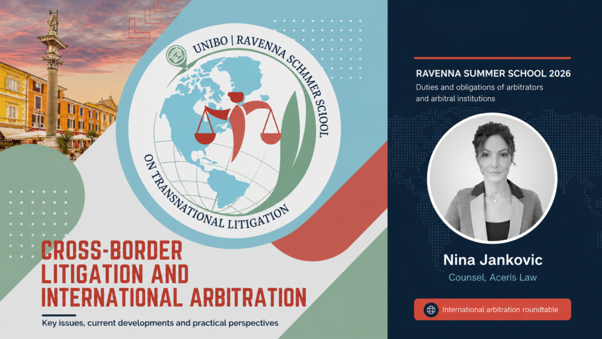
The roundtable addressed several interconnected topics, including due process and equal treatment of the parties, the duties of arbitral institutions in administering proceedings, private international law issues in arbitrator and institutional liability, the drafting and enforceability of awards, sanctions, corruption and illegality, and third-party funding disclosure. Ms Jankovic focused on sanctions, corruption and illegality, and in particular on the duties that arise when arbitrators suspect fraud, corruption, sanctions violations, money laundering or other unlawful conduct.
Why Corruption, Sanctions and Illegality Matter in Arbitration
International arbitration is valued for neutrality, flexibility and enforceability. Those advantages can be compromised where the underlying transaction is affected by bribery, fraud, sanctions evasion or money laundering. The challenge is that arbitrators are not prosecutors or regulators. They are appointed to decide a dispute between parties. At the same time, they cannot ignore credible indications that the arbitral process could be used to give effect to unlawful conduct.
Ms Jankovic emphasised that the correct approach is not to investigate every suspicion. The duty is to react properly when credible and material red flags arise. A red flag is not proof; it is a reason to ask whether proof should be organised. This distinction is essential for commercial parties, States, State-owned entities and investors facing international arbitration proceedings involving allegations of illegality.
Corruption in International Arbitration: Investment and Commercial Cases
A useful starting point is the distinction between investment treaty arbitration and commercial arbitration. In investment arbitration, illegality may affect jurisdiction where the relevant treaty requires the investment to have been made in accordance with host State law. If an investment was procured by corruption, a tribunal may conclude that treaty protection was never available. However, where the State participated in, knew of or benefited from the unlawful conduct, tribunals should be cautious before allowing the State to rely on illegality to defeat jurisdiction.
In commercial arbitration, the analysis is usually different. The tribunal’s jurisdiction normally derives from the arbitration agreement. Under the principle of separability, corruption or illegality affecting the main contract does not automatically invalidate the arbitration clause. The tribunal will generally remain competent, but the illegality may affect the merits, admissibility, remedy, costs or enforceability of the award.
Red Flags of Corruption in International Arbitration
The ICC Commission’s work on red flags provides a practical, structured framework for addressing these issues. First, the tribunal should identify the suspected illegality with precision. It should not speak vaguely about corruption. It should determine whether the concern involves bribery, trading in influence, fraud, money laundering, sanctions evasion, a sham consultancy agreement or another breach of mandatory law.
Second, the tribunal should validate the red flags. General red flags, such as a high-risk country or sector, justify caution but are usually weak on their own. Specific red flags are more probative: an intermediary recommended by a public official, opaque beneficial ownership, a shell company, excessive compensation, success fees tied to a government decision, offshore payments, lack of proof of services or refusal of anti-corruption safeguards.
Third, the tribunal should assess the full evidentiary picture. Red flags should be weighed together with green flags, such as due diligence, anti-corruption clauses, compliance approvals, audits, legal advice, transparent payments and proof that services were actually performed. Arbitrators must avoid both extremes: turning a blind eye and conducting an unlimited investigation.
Should Arbitrators Investigate Corruption Red Flags?
Ms Jankovic’s position was that arbitrators should remain within the dispute and the evidentiary record, but they are not required to remain passive when credible red flags appear from that record. The tribunal should convert suspicion into procedure: identify the concern, invite submissions, request targeted evidence where appropriate, and decide only after both parties have been heard.
That procedural discipline protects due process and equal treatment, another central theme of the roundtable. If the tribunal raises illegality itself, it must not surprise the parties in the final award. It should allow both sides to address the facts, the applicable law and the possible consequences. Proactivity is not the same as surprise.
Sanctions, Illegality and Corruption in International Arbitration
Sanctions create a different type of risk. Corruption usually asks whether a transaction was tainted in the past. Sanctions often create a present-tense compliance problem: can counsel act, can deposits be paid, can the arbitrator accept fees, can the institution administer the case, can a settlement be recorded, and can an award lawfully order payment or performance?
Arbitrators should identify applicable sanctions regimes, including those of the seat, the governing law, the institution’s place of administration, the arbitrators’ own jurisdictions and likely enforcement jurisdictions. Sanctions should not usually be treated as an automatic bar to jurisdiction. They are more often a warning sign for procedure, merits, remedy and enforcement.
P&ID and Corruption in International Arbitration
The P&ID case is a powerful illustration of how arbitration can be placed under pressure when serious illegality is not adequately tested. The case is not an example of a corrupt tribunal. Rather, it shows how even a highly experienced tribunal can be misled when the record does not reveal the full picture. The English High Court later set aside the awards, finding that they had been obtained by fraud and procured contrary to public policy, including through corrupt conduct and misuse of privileged documents (Federal Republic of Nigeria v Process & Industrial Developments Ltd [2023] EWHC 2638 (Comm), paras. 493, 497 and 574).
For businesses and States, the key lesson is practical: in large, State-related, or high-risk disputes, significant red flags must be scrutinised through fair and proportionate case management. Without this, there is a risk that arbitration could serve as a channel for monetising unlawful conduct.
Remedies and Enforceability in Corruption-Related Arbitration
Tribunals should separate jurisdiction, merits, remedy and enforcement. A tribunal may have jurisdiction and may even find a breach, but that does not mean it must grant every remedy requested. The key question is not only whether a contractual right exists. The tribunal must also ask whether the award itself would become the vehicle through which unlawful conduct is carried out.
In practice, tribunals may declare rights but refuse specific performance, sever lawful and unlawful claims, deny damages linked to corrupt payments, make payment conditional on licences or authorisations, or refuse to record a settlement as a consent award if it appears designed to evade sanctions or disguise suspicious payments. A consent award should not become a compliance bypass.
Key Takeaway for Parties in International Arbitration
The broader roundtable confirmed that arbitrator duties are no longer limited to deciding the case efficiently. Parties increasingly expect tribunals and institutions to manage due process, transparency, conflicts, funding, liability, award drafting and enforceability with practical judgment. In cases involving sanctions, corruption, or illegality, the key is to approach the issues carefully, thoughtfully, and with discipline.
Arbitrators should not step outside the dispute to conduct their own criminal or sanctions investigation. However, where credible and material red flags emerge from the record, they should take proportionate procedural steps to test them, hear both parties and ensure that the award does not order, facilitate or give effect to unlawful performance, payment, enforcement or other unexamined illegality.
Aceris Law regularly assists clients in international arbitration matters involving complex questions of jurisdiction, public policy, sanctions, corruption allegations, enforceability and award strategy. Early assessment of these issues can be decisive for protecting rights, managing procedural risk and improving prospects of successful enforcement.
