
On 28 May 2026, the United States Supreme Court issued its unanimous decision in Flowers Foods, Inc. v. Brock, further clarifying the scope of the Federal Arbitration Act (“FAA”) § 1 exemption for transportation workers.
The FAA requires courts to enforce private arbitration agreements. However, § 1 of the FAA provides an important exception for disputes involving the contracts of employment of, inter alia, any “class of workers engaged in foreign or interstate commerce”.[1]
The case addressed whether a worker may qualify as part of such a “class of workers engaged in […] interstate commerce” even when he or she never crosses state lines and never interacts with vehicles that do. The Court answered yes, holding that a worker who transports goods on an intrastate leg of a continuous interstate journey may fall within the § 1 exemption.
 The decision is significant because it resolves a disagreement among the courts of appeals concerning so-called “last-mile” or intrastate delivery workers who handle the final leg of a product’s journey, usually from a warehouse, distribution centre, store, or restaurant to the end customer. In particular, it rejects the narrower approach adopted by the Fifth and Eleventh Circuits, which had focused on whether the worker’s class itself crossed borders or whether the interstate journey had effectively ended before the worker’s local delivery route began.
Background
This case involved a franchisee, Angelo Brock (“Brock”), who entered into a distribution agreement with Flowers Foods, Inc. (“Flowers”), one of the Nation’s largest producers of packaged baked goods, under which Brock picked up Flowers’s products at a warehouse in Colorado and delivered them to local stores without leaving the state.[2] Brock sued Flowers in federal district court for various alleged violations of federal and state laws, which Flowers countered with a motion asking the court to compel arbitration.[3] Flowers argued that Brock was bound by the arbitration clause in the distribution agreement.[4] The district court denied Flowers’s motion, and the Tenth Circuit affirmed.[5]
The Tenth Circuit based its decision on 9 U.S.C. §1 and reasoned that Brock could belong to a class of workers engaged in interstate commerce despite the fact that he does not cross state lines because his “‘intrastate route formed a constituent part of the […] interstate journey’ of Flowers’s goods from out-of-state bakeries to their intended destinations at retail stores.”[6]
Flowers then petitioned for certiorari, asking the Supreme Court to answer the following question: Can someone qualify as a worker “engaged in […] interstate commerce” under §1 if he never crosses state lines and never interacts with vehicles that do?[7]
The Supreme Court
The Supreme Court unanimously affirmed the judgment of the Tenth Circuit in an eight-page opinion.
The Court started by looking at the statutory text of the exemption, finding that nothing in the terms “engage” – meaning to take part in or be employed or involved in – or “interstate commerce” – meaning the transportation of persons or property between or among the several states, or from or between points in one state and points in another state – requires an individual to cross state lines or interact with a vehicle that does.[8] The Court reasoned that a person could take part, be employed, or be involved in the continuous intrastate journey of products without leaving a state or touching vehicles that do.[9]
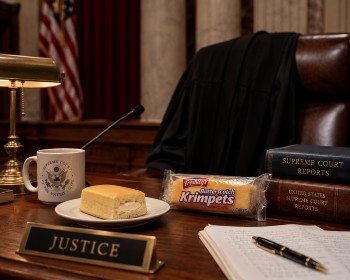
The Court set out a hypothetical where Customer A in State A enters a contract to buy Butterscotch Krimpets from Company B in State B, and Company B hires three drivers to transport them to Customer A – Driver 1 to take the Krimpets up to the state line and unload them in State B, Driver 2 to pick up the Krimpets, carry them 10 feet over the state line from State B to State A and unload them, and Driver 3 to pick them up at the state line in State A and take them to Customer A.[10]
According to Flowers’s reading of the exemption, only Driver 2 would be engaged in interstate commerce, but the Court found that this interpretation cannot be right: each of the drivers played a “direct, active, and necessary part in ensuring the Krimpets got from a point in State B (the bakery) to a point in State A (the headquarters) as the contract required.”[11]
The Court then recalled several cases from before and around the time of the FAA’s adoption in which it held similarly:
- The Daniel Ball – finding that a steamer transporting goods on Grand River entirely within the limits of the State of Michigan was engaged in interstate commerce;[12]
- Rearick v. Pennsylvania – finding that a salesman who picked up goods shipped from out of state and delivered them to their final destination was engaged in interstate commerce;[13]
- Rhodes v. Iowa – holding that a railroad agent who moved a package from a train platform to a freight warehouse entirely within one state could be part of interstate commerce transportation;[14] and
- Norfolk & Western R. Co. Pennsylvania – holding that an intrastate portion of an interstate railroad business was immediately connected with interstate commerce.[15]
The Court noted that while these cases concerned the Constitution’s Commerce Clause, not §1 of the FAA, and while the scope of §1 is not coterminous with the scope of the Commerce Clause, cases using the same or substantially similar language as §1 “offer probative evidence of what an ordinary person at the time of the FAA’s enactment would have understood its terms to mean.”[16]
The Court also declined to address other potential limits on § 1’s exemption. Flowers had suggested that Brock might not qualify because he operated through an independently owned company, and because he ordered, purchased, and took title to Flowers’s goods before selling them to local stores.[17] The Court did not decide the legal significance of those facts, explaining that Flowers had not squarely presented them as grounds for decision.[18]
Instead, Flowers asked the Court to adopt “a bright-line rule that an individual can never qualify for §1’s exemption unless he crosses state lines or interacts with vehicles that do”.[19] However, according to the Court, “whatever other limits §1 may or may not contain, we do not see how the statutory text can support that one.”[20]
What the Decision Means Going Forward
Flowers Foods is important less because it answers every question about FAA § 1, and more because it rejects a categorical limitation that had narrowed the exemption in some lower courts. As the Supreme Court noted in its decision, Flowers Foods forms part of a line of cases from the past ten years, New Prime Inc. v. Oliveira, Southwest Airlines Co. v. Saxon, and Bissonnette v. LePage Bakeries Park St., LLC, in which the Supreme Court has rejected efforts to reduce the exception’s scope.[21]
After Flowers Foods, courts may no longer treat intrastate work as outside § 1 merely because the worker does not personally cross state lines or interact with vehicles that do. The relevant inquiry is instead whether the worker’s intrastate route forms part of a continuous interstate journey and whether the worker plays a direct, active, and necessary role in moving goods between states.
This is likely to matter most in cases involving last-mile and final-mile delivery workers. Before Flowers Foods, some courts focused heavily on whether goods had already arrived at a local warehouse or distribution centre before being delivered to local customers. For example, the Fifth Circuit in Lopez v. Cintas Corp. reasoned that once goods arrived at a Houston warehouse and were unloaded, workers later delivering those goods locally were no longer engaged in interstate commerce.[22] Similarly, the Eleventh Circuit in Hamrick v. Partsfleet, LLC emphasised that the inquiry should focus on whether the class of workers itself actually engaged in foreign or interstate commerce, not merely on whether the goods had previously crossed state lines.[23]
The Supreme Court’s decision shifts the emphasis. The fact that a worker operates only within one state, or handles goods after they have been unloaded at an in-state facility, is no longer dispositive. What matters is whether the worker’s role is part of the goods’ continuing interstate movement to their intended destination.
The decision will be particularly important for businesses that rely on local delivery networks to complete the final leg of interstate distribution, including food and beverage producers, retailers, e-commerce companies, logistics providers, uniform and facilities suppliers, and other companies that move goods through regional warehouses before delivery to local customers. It will also matter for franchisees, independent contractors, owner-operators, and other delivery workers whose agreements contain arbitration clauses but whose work may form part of a broader interstate distribution chain.
For those parties, Flowers Foods shifts attention away from formal markers such as whether the worker personally crossed state lines and toward the practical role the worker plays in the movement of goods. Employers seeking to compel arbitration can no longer rely solely on the fact that a worker’s route was intrastate or that goods had been unloaded at an in-state facility. Workers resisting arbitration, in turn, are likely to focus on whether their deliveries were part of a continuous interstate journey to the goods’ intended destination. Future disputes will likely turn on facts such as the structure of the distribution chain, the point at which the goods’ interstate journey ended, whether the local delivery was contemplated as part of that journey, and whether the worker’s role was direct, active, and necessary to completing it.
Conclusion
The decision in Flowers Foods does not mean that every local delivery worker will automatically fall within § 1 of the FAA. The Court expressly left open other possible limits on the exemption, including the relevance of contractual structure, independent business entities, or the transfer of title to goods. But the Court made clear that § 1 does not impose the bright-line limitation urged by Flowers. A worker may be engaged in interstate commerce even if his work is entirely intrastate, provided that his role forms part of the continuous movement of goods across state lines.
[1] 9 U.S.C. § 1.
[2] Flowers Foods, Inc. v. Brock, No. 24–935 (U.S. May 28, 2026), pp. 1-2.
[3] Flowers Foods, Inc. v. Brock, No. 24–935 (U.S. May 28, 2026), p. 2.
[4] Flowers Foods, Inc. v. Brock, No. 24–935 (U.S. May 28, 2026), p. 2.
[5] Flowers Foods, Inc. v. Brock, No. 24–935 (U.S. May 28, 2026), p. 2.
[6] Flowers Foods, Inc. v. Brock, No. 24–935 (U.S. May 28, 2026), p. 2.
[7] Flowers Foods, Inc. v. Brock, No. 24–935 (U.S. May 28, 2026), p. 3.
[8] Flowers Foods, Inc. v. Brock, No. 24–935 (U.S. May 28, 2026), p. 4.
[9] Flowers Foods, Inc. v. Brock, No. 24–935 (U.S. May 28, 2026), p. 4.
[10] Flowers Foods, Inc. v. Brock, No. 24–935 (U.S. May 28, 2026), p. 5.
[11] Flowers Foods, Inc. v. Brock, No. 24–935 (U.S. May 28, 2026), p. 5.
[12] Flowers Foods, Inc. v. Brock, No. 24–935 (U.S. May 28, 2026), pp. 5-6.
[13] Flowers Foods, Inc. v. Brock, No. 24–935 (U.S. May 28, 2026), p. 6.
[14] Flowers Foods, Inc. v. Brock, No. 24–935 (U.S. May 28, 2026), p. 6.
[15] Flowers Foods, Inc. v. Brock, No. 24–935 (U.S. May 28, 2026), p. 6.
[16] Flowers Foods, Inc. v. Brock, No. 24–935 (U.S. May 28, 2026), pp. 6-7.
[17] Flowers Foods, Inc. v. Brock, No. 24–935 (U.S. May 28, 2026), pp. 7-8.
[18] Flowers Foods, Inc. v. Brock, No. 24–935 (U.S. May 28, 2026), p. 8.
[19] Flowers Foods, Inc. v. Brock, No. 24–935 (U.S. May 28, 2026), p. 8.
[20] Flowers Foods, Inc. v. Brock, No. 24–935 (U.S. May 28, 2026), p. 8.
[21] Flowers Foods, Inc. v. Brock, No. 24–935 (U.S. May 28, 2026), p. 3.
[22] Lopez v. Cintas, 47 F.4th 428 (5th Cir. 2022).
[23] Hamrick v. Partsfleet LLC, 1 F.4th 1337 (11th Cir. 2021).
