
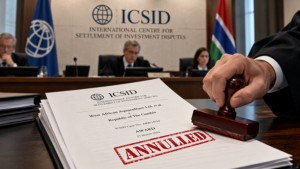
On 17 July 2026, an ad hoc committee (the “Committee”) of the International Centre for Settlement of Investment Disputes (“ICSID”) annulled in its entirety the award dated 25 March 2024 (the “Award”) against the Republic of The Gambia (“The Gambia”). The decision on annulment (the “Decision”) identified a gap in the reasoning supporting consent to ICSID jurisdiction. Because the missing explanation concerned the jurisdictional foundation of the Award, the Committee concluded that the defect warranted annulment of the Award in its entirety and found no basis to exercise any discretion to preserve it.[1]
The Committee based the annulment solely on Article 52(1)(e) of the Convention on the Settlement of Investment Disputes between States and Nationals of Other States (the “ICSID Convention”), which permits annulment for failure to state the reasons on which an award is based. It expressly took no position on the proper interpretation of the Gambian legislation allegedly providing consent and did not determine the separate allegation of manifest excess of powers. The Decision therefore illustrates both the requirement for intelligible jurisdictional reasoning and the limits of annulment review.[2]
Facts
 The dispute concerned a shrimp-farming investment of West African Aquaculture Ltd. (“WAA”) and two other claimants (together, the “Claimants”). The investment was nationalised on 12 June 2015, and Gambian military forces seized the farm that month. WAA sought an amicable settlement and compensation through discussions with the authorities, but no settlement was reached. The timing of the taking, the subsequent statutory changes and the commencement of arbitration became central to the jurisdictional dispute.[3]
At the time of nationalisation, The Gambia Investment and Export Promotion Agency Act, 2010 (the “2010 Act”) was in force. Section 55 provided that, following unsuccessful conciliation or mediation, the parties could resort to specified dispute resolution mechanisms, expressly including ICSID. The Gambia Investment and Export Promotion Agency Act, 2015 (the “2015 Act”) entered into force on 31 December 2015 and replaced the 2010 Act. Section 35 of the 2015 Act retained references to domestic arbitration and bilateral investment treaties, omitted the 2010 Act’s express reference to ICSID, and included “the provisions of any international treaty to which The Gambia is party”.[4]
WAA submitted its request for arbitration to ICSID on 22 February 2018, initially relying on the 2010 Act. Following exchanges with the ICSID Secretariat, the Claimants clarified that they relied on the 2015 Act and, alternatively, the 2010 Act. The arbitral tribunal (the “Tribunal”) subsequently considered that the Claimants appeared to have relied in good faith on the earlier statutory offer during their exchanges with The Gambia and that the authorities had not corrected their understanding that the 2010 Act remained in force. Those findings about reliance and State conduct became central to the Tribunal’s jurisdictional reasoning.[5]
In the Award, the Tribunal upheld jurisdiction under Section 35 of the 2015 Act, found that The Gambia had unlawfully expropriated the Claimants’ investment and ordered compensation. The Award was issued by a majority, with Professor Pierre Mayer dissenting on jurisdiction and partly on the merits. The Gambia sought annulment on two grounds: manifest excess of powers under Article 52(1)(b) of the ICSID Convention and failure to state reasons under Article 52(1)(e).[6]
Issues
The principal question was whether the Award explained how the written-consent requirement in Article 25(1) of the ICSID Convention had been satisfied and why Section 35 of the 2015 Act established jurisdiction. In particular, could an informed reader follow the reasoning from the Tribunal’s reliance on the 2010 Act and the parties’ conduct to its conclusion that jurisdiction existed under the 2015 Act? The Committee also had before it The Gambia’s separate contention that the Tribunal had manifestly exceeded its powers.[7]
Two ancillary issues concerned the admissibility of The Gambia’s expert reports and supporting materials on Gambian law, which the Claimants sought to exclude, and the allocation of the costs of the annulment proceeding.[8]
Holding
The Committee held that the Award failed to state the reasons on which it was based, within the meaning of Article 52(1)(e) of the ICSID Convention. An award must allow an informed reader to follow the reasoning connecting its premises to its conclusions on an issue that determines the outcome. Here, the Tribunal had not explained the connection between the requirement of written consent and its finding of jurisdiction under Section 35 of the 2015 Act. The resulting defect affected the basis of jurisdiction and warranted annulment of the Award in its entirety.[9]
The Committee took no view on the proper interpretation of Section 35 and did not decide the manifest-excess-of-powers ground. It dismissed the Claimants’ request to exclude the Gambian-law expert reports and identified supporting exhibits. Each party was ordered to bear its own legal and other costs and half of the costs of the annulment proceeding, which totalled USD 426,090.34. As The Gambia had advanced those costs, the Claimants were ordered to reimburse it USD 213,045.17.[10]
Reasoning
The Committee’s starting point was the limited function of review under Article 52(1)(e). Drawing on established ICSID annulment jurisprudence, it explained that the duty to give reasons requires an award to be intelligible on questions of fact and law. The provision does not authorise an annulment committee to decide whether the tribunal’s reasoning was correct or convincing. Reasons may be succinct, and an apparent tension between competing considerations should not automatically be treated as a contradiction that destroys the reasoning.[11]
The Committee formulated three cumulative conditions for annulment on this ground: the award gives insufficient, inadequate, frivolous, contradictory or no reasons for its decision on a particular question; that question determines the outcome; and the deficiency makes it impossible to follow the tribunal’s reasoning from its starting point to its conclusion. Read together, these conditions focus on intelligibility. The references to insufficient or inadequate reasons do not create an independent power to reassess the substantive quality of the tribunal’s legal analysis.[12]
Applying that standard, the Committee examined how the Tribunal had moved from Article 25(1)’s requirement of written consent to its conclusion that Section 35 of the 2015 Act established jurisdiction. The Tribunal had recognised that consent should not be presumed and had to be clearly demonstrated. It nevertheless approached the statutory question indirectly: it first identified an offer of ICSID arbitration in Section 55 of the 2010 Act and then asked whether the 2015 Act had revoked that offer for these particular Claimants.[13]
The Tribunal expressly declined to determine whether Section 35 provided advance consent to ICSID arbitration “in the abstract”. Its analysis instead focused on the Claimants’ reliance on the earlier offer and The Gambia’s failure to correct their understanding during the parties’ exchanges. The Tribunal reasoned that an offer made under legislation subsequently repealed and replaced could potentially be accepted under the new legislation if the latter did not revoke the earlier offer on its face. It treated this as a matter of assessing the circumstances of the case.[14]
For the Committee, that approach introduced an unexplained presumption. By asking whether the 2015 Act revoked or foreclosed the earlier offer, the Tribunal effectively presumed that Section 35 contained consent unless it revoked the earlier offer “on its face”. Apart from referring to the circumstances of the case, the Tribunal supplied no reasons for that presumption. The presumption also contradicted the Tribunal’s earlier statement that consent must be clearly demonstrated rather than presumed.[15]
The Tribunal’s observation that the wording of Section 35 was broad enough to encompass an offer of ICSID arbitration did not resolve the difficulty. In the Committee’s reading, the Tribunal had inferred consent from the Claimants’ reliance on the 2010 Act and the authorities’ conduct, without explaining how those matters established written consent under the provision on which jurisdiction was formally based. An informed reader could therefore identify the legal premise and the jurisdictional conclusion, but could not follow the essential reasoning connecting them.[16]
The missing explanation was specific. The Tribunal did not reconcile the requirement of written consent with its refusal to decide whether Section 35 contained advance consent generally, or explain how that provision instead contained consent addressed to these Claimants in particular. Nor did it explain how conduct concerning the 2010 Act established written consent under the 2015 Act. The Committee treated that gap as an annullable error. Its analysis concerned the absence of the necessary explanation, without resolving the proper statutory interpretation itself.[17]
The Claimants sought to defend the Tribunal’s approach by reference to the judgment of the International Court of Justice (the “ICJ”) in Fisheries Jurisdiction (Spain v. Canada) (“Fisheries Jurisdiction”). They argued that the interpretation of unilateral declarations allowed consideration of successive declarations and third parties’ reactions. The Committee observed that, although the ICJ had permitted comparison of successive declarations to ascertain a State’s intentions, the declaration in existence remained the instrument to be interpreted. It found that the Tribunal had focused instead on the earlier declaration and the parties’ conduct. The Committee further observed that Fisheries Jurisdiction did not identify third-party reactions as a relevant consideration in interpreting unilateral declarations and that the Tribunal had not suggested otherwise. This defence therefore did not supply the missing explanation in the Award.[18]
The defect’s jurisdictional significance determined the scope of annulment. The Committee considered that a failure to explain a finding necessary to establish consent to jurisdiction was necessarily significant to the parties’ legal rights. It therefore found no basis to exercise whatever discretion it might possess to leave the Award standing despite the defect. Because the missing reasons concerned jurisdiction, the Award was annulled in full.[19]
The Committee then declined to consider manifest excess of powers. That conclusion rested both on judicial economy and on the nature of the reasoning defect: without an intelligible explanation of the Tribunal’s jurisdictional determination, assessing whether it had manifestly exceeded its powers was neither appropriate nor feasible. The Committee expressly confined its annulment determination to Article 52(1)(e) and took no view on the proper interpretation of Section 35. Its ruling therefore cannot be treated as a determination that the 2015 Act could never provide consent to ICSID arbitration.[20]
The ruling on expert material addressed a different question. The Gambia had obtained leave to submit expert analysis of Gambian law directed to the manifest-excess-of-powers ground, subject to a prohibition on introducing new factual evidence. The Claimants argued that the reports and supporting materials impermissibly supplemented the arbitration record. The Committee rejected an approach that treated the domestic-law material exclusively as evidence of facts. Where domestic legislation is invoked as the source of consent, its interpretation may present a preliminary question of domestic law, even though jurisdiction ultimately remains a question of international law. Materials addressing that issue could therefore qualify as legal authorities.[21]
The Committee consequently refused to strike the reports and specified supporting exhibits from the record. It stressed, however, that admissibility did not determine their relevance to the manifest-excess-of-powers allegation. That allegation was ultimately left undecided. The procedural ruling should therefore not be read as an endorsement of the experts’ substantive conclusions or as the basis on which the Award was annulled.[22]
Finally, the Committee distinguished success in obtaining annulment from entitlement to recover legal costs. Exercising its broad discretion over costs, it reasoned that successful annulment did not, in itself, make the party defending the award responsible for the defect. It therefore saw no basis to shift The Gambia’s legal and other costs to the Claimants. Equal allocation of the costs of the annulment proceeding, together with each side bearing its own legal and other costs, reflected that distinction.[23]
Conclusion
The Decision is relevant to investment arbitrations founded on domestic legislation because it identifies the explanation required when jurisdiction depends on successive statutes and the parties’ conduct. A tribunal must make clear how its analysis establishes the written consent required by Article 25(1) under the legal provision on which it relies. Extensive discussion of an earlier offer, investor reliance and State conduct cannot cure an unexplained step between that analysis and the jurisdictional conclusion.[24]
For parties considering annulment, the practical lesson is to identify a missing or contradictory step that prevents the reasoning from being followed on a decisive issue. Disagreement with the interpretation adopted remains insufficient. Equally, a full annulment for failure to state reasons should not be presented as a definitive ruling on the underlying claim or on the correct interpretation of the alleged source of consent. Here, the Committee expressly preserved that distinction.[25]
The ICSID Convention allows either party to request submission of the dispute to a new tribunal following annulment. The Decision thus removes this Award while leaving the substantive jurisdictional question open. Its central contribution is a concrete illustration of how a failure to explain consent can invalidate an entire award within the limited framework of ICSID annulment.[26]
[1] West African Aquaculture Ltd. et al. v. Republic of The Gambia, ICSID Case No. ARB/18/10, Decision on Annulment, 17 July 2026, ¶¶ 1, 234, 236.
[2] Id. ¶¶ 207, 237-241.
[3] Id. ¶¶ 2, 4, 226(c), 226(f)-226(g).
[4] Id. ¶¶ 221-222, 226(c), 229.
[5] Id. ¶¶ 4-5, 226(f)-226(g), 226(j).
[6] Id. ¶¶ 6-9.
[7] Id. ¶¶ 8, 216-220, 227.
[8] Id. ¶¶ 83-91, 247-250.
[9] Id. ¶¶ 214, 227, 231-234, 255(2).
[10] Id. ¶¶ 90-91, 237-241, 251-255.
[11] Id. ¶¶ 208-212.
[12] Id. ¶¶ 209, 214, 227.
[13] Id. ¶¶ 223, 226(b), 226(d)-226(e), 227-230.
[14] Id. ¶¶ 226(f)-226(i), 229-230.
[15] Id. ¶ 231.
[16] Id. ¶¶ 232-234.
[17] Id. ¶¶ 234, 237.
[18] Id. ¶ 235.
[19] Id. ¶¶ 234, 236.
[20] Id. ¶¶ 237-241.
[21] Id. ¶¶ 83-89.
[22] Id. ¶¶ 90-91, 238, 255(1)-255(2).
[23] Id. ¶¶ 250, 253-254.
[24] Id. ¶¶ 227-234.
[25] Id. ¶¶ 208-214, 236-241.
[26] ICSID Convention, Art. 52(6); West African Aquaculture Ltd. et al. v. Republic of The Gambia, ICSID Case No. ARB/18/10, Decision on Annulment, 17 July 2026, ¶¶ 234, 237, 255(2).
