
For an investor, a State, or an in-house legal team facing its first investment dispute, ICSID arbitration can appear unusually technical. It is not simply commercial arbitration administered by a familiar institution. What makes ICSID arbitration different is its treaty foundation, its particular jurisdictional requirements, its relative independence from national courts, and its self-contained system of post-award remedies and its distinctive treaty-based recognition and enforcement regime.
 ICSID’s importance is also evident from its caseload. By the end of 2025, the Centre had registered 1,085 arbitration and conciliation cases under the ICSID Convention and Additional Facility Rules, including 63 new cases in 2025.[1] The final award is only the visible endpoint of a process that is often lengthy, complex and procedurally demanding. An ICSID arbitration typically starts long before filing, with an examination of consent, jurisdiction and procedural preconditions. It then progresses through registration, the appointment of the tribunal, procedural organisation, written and evidentiary phases, and, in most cases, a hearing. Once the tribunal renders its award, the parties must still consider the available post-award remedies and, in some cases, the practical steps required to secure compliance or enforcement.
This note aims to offer a clear, step-by-step guide to how an ICSID arbitration proceeds in practice. The note focuses primarily on arbitration under the ICSID Convention and the 2022 ICSID Arbitration Rules. It also explains how that process differs from arbitration under the ICSID Additional Facility Rules and UNCITRAL arbitration administered by ICSID.[2]
1. Before Filing: Is ICSID Arbitration Available?
1.1 Begin with Article 25 and Identify the Basis of Consent
Any assessment of jurisdiction under the ICSID Convention must begin with Article 25, which establishes the outer limits of the Centre’s jurisdiction. It requires:
- a legal dispute;
- arising directly out of an investment;
- between a Contracting State, or a qualifying constituent subdivision or agency, and a national of another Contracting State; and
- the parties’ written consent to submit the dispute to ICSID.[3]
Meeting the Article 25 criteria is only the first step. The claimant must also satisfy the terms of the State’s specific offer to arbitrate, whether contained in a bilateral investment treaty, multilateral treaty, investment contract, or domestic investment law. That instrument may define “investor” or “investment” more narrowly than Article 25, exclude particular sectors or measures, impose limitation periods, reserve matters involving taxation or national security, or require specified procedural steps before arbitration may be commenced. Consent is therefore both the jurisdictional foundation of ICSID arbitration and an inquiry that depends on the precise wording of the applicable instrument. As the Report of the Executive Directors on the Convention explains, written consent, once given, cannot be withdrawn unilaterally; however, consent alone is insufficient to establish the Centre’s jurisdiction.[4]
Before filing, the jurisdictional analysis should cover four main areas:
- Ratione personae: Did the claimant satisfy the applicable nationality requirements at each legally relevant date? For natural persons, ICSID Convention jurisdiction is unavailable if the claimant also held the respondent State’s nationality on either the date of consent or the date of registration. For juridical persons, counsel should examine the place of incorporation, ownership, control, and any agreement to treat a locally incorporated entity as a national of another Contracting State because of foreign control.
- Ratione materiae: Does the dispute arise out of an “investment” protected both by Article 25 and by the applicable instrument of consent? Shares, concessions, licences, loans, and long-term contracts may qualify, but tribunals may also consider issues such as legality, territorial connection, contribution, duration, and risk.
- Ratione temporis: Were the relevant jurisdictional requirements satisfied at the appropriate times? The analysis should examine whether the treaty was in force when the investment was made and when the alleged breach occurred, as well as the date on which consent to arbitration was established. The analysis should also consider any applicable limitation period and the effect of treaty termination or a survival clause on the continued availability of protection.
- Ratione voluntatis: Does the State’s offer to arbitrate extend to the particular parties, claims, measures, and relief at issue? Reservations, denial-of-benefits clauses, waiver provisions, and restrictions on counterclaims must be examined as integral parts of the consent framework.[5]
At this stage, it is also important to distinguish jurisdiction from admissibility. A tribunal that lacks jurisdiction has no authority to decide the dispute at all. By contrast, an admissibility objection usually accepts that the tribunal has authority over the dispute but argues that the claim should not be heard in its current form or at that particular time. The distinction is not always clear-cut, especially in cases involving cooling-off periods, requirements to pursue local remedies, abuse of process, or parallel proceedings. It can also have important consequences after the award: a jurisdictional error may, if it amounts to a manifest excess of powers, provide a basis for annulment, whereas an alleged error concerning admissibility will not normally do so on its own.[6] For further analysis, see Aceris Law’s notes on consent in investment arbitration, consent based on investment codes and fork-in-the-road provisions.
1.2 Satisfy Every Pre-Arbitration Condition
Many investment treaties require the investor to send a notice of dispute or notice of intent and then allow a specified period for negotiations before arbitration may begin. Some treaties impose additional conditions, such as waiving domestic proceedings, litigating before local courts for a set period, exhausting available remedies, or choosing between court proceedings and arbitration. The notice should be addressed to the appropriate State authority, identify the investor and the investment, explain the measures in dispute and the treaty provisions allegedly breached, state the relief sought, and be sent in a way that provides reliable proof of delivery.
Filing before these requirements have been satisfied can lead to an expensive preliminary dispute. Counsel should therefore identify each pre-arbitration condition, determine when the relevant period begins and ends, and keep a clear record of compliance. Where the treaty also contains a limitation period, the filing deadline should be calculated from the outset. Parties should not assume that negotiations or settlement discussions stop the clock.[7] Aceris Law’s overview of time limits for commencing investment arbitration discusses several of the most common timing pitfalls.
1.3 Develop the Merits, Evidence, Damages and Enforcement Strategy Together
A claim may satisfy the jurisdictional requirements for ICSID arbitration and still make little commercial sense to pursue. Before filing, counsel should identify the treaty protections potentially engaged by the State’s conduct and assess the strength of any resulting claims, including claims for expropriation, breach of fair and equitable treatment or full protection and security, arbitrary or discriminatory treatment, violations of national or most-favoured-nation treatment, restrictions on the free transfer of funds, and breaches of umbrella clauses. The analysis should also identify whose conduct can be attributed to the State. Measures taken by ministries, regulators, courts, municipalities, and State-owned enterprises may engage State responsibility, but not necessarily under the same rules or on the same evidence.
Evidence should be preserved from the outset. Documents such as emails, messages, board papers, investment committee materials, financial models, permits, tax records and correspondence with government authorities may later prove important to the case. Potential witnesses should also be identified early, while events are still fresh in their minds. Issues such as privilege, translation and document integrity are easier to manage while the records are still accessible and the relevant personnel remain available.
Costs and recovery should also be considered from the outset. An ICSID arbitration can become expensive once counsel fees, experts, translation, hearings, tribunal costs and the risk of an adverse costs order are taken into account. Aceris Law’s guide to the total costs of ICSID arbitration provides a more detailed overview of the principal cost categories and the amounts parties may need to budget for. It may be useful to identify potentially recoverable State assets before filing. For that reason, the likely cost of the case, its commercial value and the prospects of enforcement should be assessed together at an early stage.[8]
2. Determining the Applicable ICSID Framework
The 2022 ICSID Rules came into force on 1 July 2022. In cases brought under the ICSID Convention, the Arbitration Rules applicable on the date the parties consented to arbitration are normally applicable, unless the parties agree otherwise.[9] The applicable Institution Rules are determined by the date on which the Request for Arbitration is filed, while the 2022 Administrative and Financial Regulations generally apply from 1 July 2022, subject to limited transitional exceptions.[10] For Additional Facility proceedings, the applicable version of the rules is generally determined by the date on which the Request for Arbitration is filed.[11]
The scope of the Additional Facility was significantly expanded in 2022. It may now be used for certain investment disputes even where one or both of the relevant States are not parties to the ICSID Convention, and it is also available where a regional economic integration organisation is a party to the dispute. The legal consequences, however, remain different from ICSID Convention arbitration: Additional Facility proceedings have a seat, are subject to the mandatory law of that seat, may be challenged before national courts, and do not benefit from the enforcement regime in Articles 53-55 of the ICSID Convention.[12]
Parties may agree to arbitrate under the UNCITRAL Arbitration Rules while asking ICSID to administer the proceedings and provide services such as appointment assistance, financial administration and hearing support.[13] This combines the procedural framework of the UNCITRAL Rules with institutional support from ICSID. ICSID’s involvement does not convert the case into an ICSID Convention arbitration: the resulting award remains a UNCITRAL award and is recognised and enforced under applicable national law and international conventions, rather than Articles 53-55 of the ICSID Convention.[14]
3. Preparing and Filing the ICSID Request for Arbitration
The Request for Arbitration is not intended to plead the claimant’s case in full. It must, however, provide a clear summary of the investment, the relevant facts and claims, the relief sought and the asserted basis for ICSID jurisdiction. At the same time, it should leave room for the evidence and legal arguments to develop. An overly detailed Request may tie the claimant to positions adopted before the factual and legal record is fully developed. A Request that is too brief, however, may prompt further questions from the Secretariat and delay registration.[15]
A non-refundable filing fee of USD 25,000 must be paid when the Request for Arbitration is submitted. As fees may change, claimants should confirm the amount in ICSID’s latest Schedule of Fees before filing.[16] Aceris Law’s note on filing an ICSID Request for Arbitration provides a practical checklist for preparing the submission.[17]
3.1 ICSID Screening and Registration
The Secretary-General will register a Request for Arbitration unless, on its face, the dispute is manifestly outside ICSID’s jurisdiction. Before doing so, the Secretariat may ask the claimant to clarify parts of the Request, provide missing documents, submit fuller translations or correct formal deficiencies. This review is deliberately limited. Registration does not amount to a decision on jurisdiction and does not prevent the tribunal from later ruling on ICSID’s jurisdiction, its own competence or any other issue in the case.[18]
Unlike ICC arbitration and many other commercial arbitration rules, the 2022 ICSID framework does not require the respondent to file an Answer to the Request at the registration stage. Instead, once the Request is filed, ICSID transmits it to the respondent and screens it for registration. The respondent will usually use the period following registration to appoint counsel, preserve relevant evidence, assess jurisdiction and the merits, develop its approach to tribunal appointments and prepare for the first advance on costs and the initial procedural discussions.[19]
4. Constitution of the Arbitral Tribunal
After registration, the next step is the constitution of the tribunal. The parties may agree on a sole arbitrator or any uneven number of arbitrators, as well as the method of appointment. If no agreement is reached within 45 days, the default three-member structure applies: each party appoints one arbitrator, and the parties jointly appoint the president. If the tribunal is still incomplete 90 days after registration, either party may ask the Chair of the ICSID Administrative Council to make the outstanding appointments.[20]
Choosing the arbitrators may be the most important decision in an ICSID arbitration. In the absence of binding precedent, different tribunals can take markedly different approaches to the same legal questions, meaning that tribunal composition can have a significant influence on the outcome of an ICSID arbitration. Parties should look beyond legal expertise and consider language skills, procedural style, availability, writing ability, previous appointments, possible issue conflicts and the ability to work effectively with the other members of the tribunal. An arbitrator’s prior awards, decisions and writings may be highly relevant, particularly where they reveal a clearly expressed view on a disputed issue likely to arise in the case. However, even an excellent arbitrator can be a poor choice if limited availability causes serious delay.
Under the 2022 ICSID Arbitration Rules, each arbitrator must sign a declaration addressing independence, impartiality, availability and confidentiality, and must disclose relevant circumstances on an ongoing basis. A proposal to disqualify an arbitrator must be filed after the constitution of the tribunal and within 21 days after the later of the tribunal’s constitution or the date on which the proposing party first knew, or first should have known, the facts on which the proposal is based. The filing of a disqualification proposal suspends the proceeding, except to the extent the parties agree to continue it.[21]
The 2022 ICSID Arbitration Rules require parties to disclose third-party funding. A funded party must identify the funder and, where the funder is a legal entity, the persons or entities that ultimately own or control it. This disclosure is provided to proposed and appointed arbitrators so that potential conflicts can be identified early. The tribunal may also request further information where necessary.[22]
5. The First Session and Procedural Order No. 1
The first session is used to determine how the arbitration will proceed. It should normally be held within 60 days after the tribunal is constituted and is now usually conducted by videoconference. In advance, the tribunal asks the parties to comment on matters such as the applicable rules, procedural language, filing arrangements, written submissions, document production, hearing format and location, the timetable, transcripts, publication and confidentiality.
Within 15 days after the later of the first session or the parties’ final procedural comments, the tribunal issues an order setting out the agreed procedural arrangements and resolving any outstanding procedural matters. This order is usually referred to as Procedural Order No. 1.[23]
Procedural Order No. 1 establishes the working framework for the arbitration. It typically addresses matters such as page limits, filing formats, exhibit numbering, confidentiality, privilege, document production, hearing dates, witness order and any alternative timetables required if bifurcation is being considered. The tribunal may also convene further case-management conferences to narrow the issues, identify matters that are not in dispute and keep the proceedings efficient and focused.
Once the case is registered, ICSID begins requesting payments to cover the anticipated costs of the proceedings. The claimant is first asked to make an initial payment to cover the Centre’s estimated costs up to the first session. After the tribunal is constituted, the parties will usually be asked to contribute equally to later stages of the arbitration, although they may agree otherwise or the tribunal may order a different arrangement. ICSID may request further payments as the case progresses. If the required amounts are not paid, the proceedings may be suspended and, ultimately, discontinued. These payments simply keep the arbitration funded; they do not determine how the tribunal will allocate costs in the award.[24]
6. Early Applications: Summary Dismissal, Bifurcation and Interim Protection
Several procedures available under the 2022 ICSID Rules can affect the sequence, scope and pace of the arbitration.
6.1 Manifest Lack of Legal Merit
A party may seek early dismissal of a claim that is manifestly without legal merit, whether because of the substance of the claim, a lack of ICSID jurisdiction or a lack of tribunal competence. The objection must generally be filed within 45 days after the tribunal is constituted, after which the tribunal applies a shortened procedural timetable. Because the threshold is deliberately high, the procedure is intended for clear defects that can be resolved without extensive factual inquiry.[25]
6.2 Preliminary Objections and Bifurcation
A tribunal may bifurcate the proceedings by deciding a jurisdictional or competence objection in a separate preliminary phase before moving to the merits. Whether it does so will depend on the potential savings in time and cost, the extent to which the objection could dispose of the dispute, and whether the issues can be separated from the merits.[26] (Bifurcation is not limited to jurisdictional objections; for example, liability may be determined separately from quantum.)
The benefits can be significant where a focused objection may end the case before a full merits phase becomes necessary. The risks are equally real: if the objection fails, the parties may have duplicated submissions and evidence and extended the overall timetable. The question is therefore a practical one: whether the proposed sequence is likely to make the proceedings fairer, more focused and more efficient.
6.3 Provisional Measures and Security for Costs
A tribunal may recommend provisional measures necessary to preserve a party’s rights. In deciding a request, it considers all relevant circumstances, including whether the measures are urgent and necessary and their effect on each party. They may be sought to protect a party’s rights, preserve evidence, prevent imminent harm, safeguard the arbitral process or maintain the status quo. The application should identify the right concerned, the measure requested and the circumstances that make relief urgent and necessary. The tribunal must also consider the consequences for the other party and should decide the request within the timetable set by the 2022 Rules.[27]
The 2022 ICSID Rules contain a dedicated procedure for security for costs. At the request of a party, the tribunal may order a party asserting a claim or counterclaim to provide security against a possible adverse decision on costs. In deciding the request, the tribunal must consider all relevant circumstances, including that party’s ability and willingness to satisfy an adverse costs decision, the effect of the order on its ability to pursue the claim or counterclaim, and the parties’ conduct. The tribunal must also consider evidence of third-party funding, although funding alone is not sufficient to justify an order. Failure to comply may lead to suspension and, if the non-compliance continues, discontinuance of the proceedings.[28]
Related arbitrations may be consolidated or coordinated only with the agreement of the parties. Consolidation merges the cases into a single proceeding that results in one award. Coordination is more limited. It allows selected procedural steps to be aligned, while the arbitrations remain separate and each results in its own award.[29]
7. The Written Phase, Evidence and Transparency
The written phase will usually consist of a memorial, counter-memorial, reply and rejoinder:
- The memorial presents the claimant’s factual and legal case and sets out the relief sought.
- The counter-memorial responds to that case, indicating which facts are accepted or disputed and setting out any additional facts and legal arguments.
- The reply and rejoinder should focus on answering the previous submission and dealing with genuinely new issues.
- Any further written submissions normally require the tribunal’s permission.[30]
Evidence is invariably filed with the written submission it supports. Each party must prove the facts on which its case depends, while the tribunal decides whether the evidence is admissible and how much weight to give it.
Document production is generally limited, rather than resembling broad disclosure in domestic litigation. In deciding whether to order production, the tribunal will consider the document’s relevance and materiality, the burden involved in producing it, the timing of the request and any objections raised. Redfern Schedules and the IBA Rules on the Taking of Evidence are commonly used to structure the process, but the tribunal retains control under the ICSID Rules.[31]
Witnesses usually present their evidence in signed written statements and may then be examined at the hearing. Experts generally follow the same approach, although the tribunal may also appoint its own expert. Procedural Order No. 1 should address practical matters such as witness conferencing, expert conferencing, interpretation and translation, remote testimony, demonstrative exhibits and the consequences of a witness’s failure to appear.[32]
Parties should not assume that an ICSID arbitration will remain entirely confidential. The 2022 ICSID Rules allow awards, decisions, orders and other case documents to be published, subject to safeguards for confidential or protected information. Hearings may also be open to observers unless a party objects, and tribunals may accept submissions from non-disputing parties and non-disputing States that are parties to the relevant treaty.[33]
8. The Hearing and Post-Hearing Phase
Unless the parties agree otherwise, the tribunal will hold one or more hearings. After consulting the parties, the tribunal determines the timing and format of the hearing. It may be held in person, remotely or in a hybrid format. The parties may agree on another place for an in-person hearing after consulting the Tribunal and the Secretary-General; absent agreement, the hearing is held at ICSID’s seat in Washington, D.C. Paris is also a frequently used ICSID hearing location. The choice of venue is a matter of practical convenience and does not give an ICSID Convention arbitration a national arbitral seat.[34]
A pre-hearing conference is usually used to discuss the practical arrangements for the hearing, including the timetable, opening submissions, witness order, examination procedure, time limits, hearing bundles, demonstratives, confidentiality, interpretation, transcripts and technology. It also gives the tribunal and the parties a final opportunity to narrow the issues, so that the hearing focuses on points that genuinely require oral evidence or argument rather than repeating the written submissions.[35]
After the hearing, the tribunal may ask the parties for post-hearing briefs, replies to specific questions, revised damages calculations, updated interest schedules and submissions on costs. Unlike the 2006 ICSID Rules, the 2022 ICSID Arbitration Rules contain no express procedure for formally closing the proceedings. Instead, Rule 58 calculates the deadline for rendering the award by reference to the last submission in the relevant proceeding or phase. Statements of costs and submissions on the allocation of costs filed under Rule 51 are expressly excluded from that calculation.[36]
9. Settlement, Suspension and Discontinuance
Settlement remains possible throughout the arbitration. If the parties reach agreement before the award is rendered, they may ask the tribunal to discontinue the proceeding or to embody their settlement in an award. The latter may be useful where the parties want the settlement to benefit from the recognition and enforcement regime of the ICSID Convention.
Once a case has been registered, however, the claimant may not always be able to withdraw it on its own. A joint request will bring the proceedings to an end by agreement. If only one party seeks discontinuance, the other is given an opportunity to object. The case will be discontinued if no objection is made within the relevant period, but it will continue if an objection is filed. Proceedings may also be discontinued after prolonged inactivity or failure to pay the required advances.[37]
10. Deliberations, Costs and the ICSID Award
The tribunal’s deliberations are private and confidential. Its decisions are taken by majority vote, and an abstention is treated as a negative vote. The ICSID Rules do not contain the institutional scrutiny procedure found in ICC arbitration, under which the ICC Court reviews and approves the form of a draft award before it is issued. Responsibility for deciding the questions submitted and giving reasons for the award remains with the ICSID tribunal.[38]
Rule 58 of the ICSID Rules requires the tribunal to issue the award as soon as possible. Depending on the stage and nature of the case, the deadline is 60, 180 or 240 days from the relevant last submission. If the tribunal cannot meet that deadline, it must explain why and indicate when the award is expected.[39]
Tribunals have considerable discretion when allocating costs. Under the 2022 ICSID Rules, they may take into account the outcome of the case, the parties’ conduct, the complexity of the proceedings and whether the costs claimed were reasonable. There is no single formula that applies in every case, but efficiency, success on particular issues and unnecessary procedural conduct may all influence the final allocation.[40]
Once the award has been signed by the members of the tribunal who voted for it, the Secretary-General promptly dispatches a certified copy to each party. The award is deemed to have been rendered on the date those certified copies are dispatched.[41] An arbitrator may attach a separate or dissenting opinion, but the award itself remains the decision of the tribunal’s majority.
11. Post-Award Remedies Under the ICSID Convention
An ICSID award is final and binding. It is not subject to appeal or review by national courts, and may be challenged only through the remedies expressly provided by the ICSID Convention.[42] Those remedies serve different purposes. Some allow the tribunal to complete, correct, clarify or revise the award, while annulment provides a separate and narrowly confined form of review.
11.1 Supplementary Decision, Rectification, Interpretation and Revision
A request for a supplementary decision or rectification is not an opportunity to revisit the merits. It must point to a question the tribunal failed to decide or to a clerical, arithmetical or similar error in the award. The request must be filed within 45 days, and that deadline cannot be extended. Any resulting decision forms part of the award and starts new time periods for revision and annulment.[43]
Interpretation is available where the parties genuinely disagree about what the award means or how far it extends. It is not a way to challenge the tribunal’s reasoning. Revision is even more limited: it requires the discovery of a decisive fact that was unknown to both the tribunal and the applicant when the award was rendered, provided the applicant was not negligent in failing to discover it earlier. Where possible, both applications are considered by the original tribunal.[44]
11.2 Annulment Is Not an Appeal
Annulment is available only on five limited grounds:
- the tribunal was improperly constituted;
- it manifestly exceeded its powers;
- one of its members was corrupt;
- there was a serious departure from a fundamental procedural rule; or
- the award failed to give reasons.
The application is heard by a specially appointed ad hoc committee, rather than by the original tribunal or a national court.[45]
The annulment committee does not determine whether the tribunal reached the “correct” result. Its role is to safeguard the integrity of the arbitral process, not to reconsider the substantive outcome. ICSID’s 2024 Updated Background Paper confirms that annulment remains exceptional: as of 31 December 2023, 1.6% of ICSID Convention awards had been annulled in full and 3.7% partially.[46] Parties should therefore avoid presenting an annulment application as a disguised appellate brief. Aceris Law’s note on the costs of ICSID annulment proceedings provides additional context. Given the low rate of successful annulment, it is particularly important for parties to present their case as effectively and comprehensively as possible before the original tribunal, rather than relying on post-award proceedings to correct an unfavourable outcome.
A party seeking revision or annulment may request a stay of enforcement of all or part of the award. If the request is included in the application, enforcement is provisionally stayed until the reconstituted tribunal or ad hoc committee decides whether the stay should continue. Under the 2022 ICSID Rules, the tribunal or committee must decide the request within 30 days after the later of its constitution or the last submission on the request, and may impose conditions for the stay or for lifting it. It ends when the decision on the application is dispatched or the proceeding is discontinued. If the award is annulled in whole or in part, either party may request that the annulled aspects of the dispute be submitted to a newly constituted tribunal. The new tribunal must nevertheless determine its own jurisdiction, and any parts of the award that were not annulled cannot be reopened.[47]
12. Compliance, Recognition, Enforcement and Execution
Four concepts should be distinguished when considering the practical effect of an ICSID award:
- Compliance: voluntary performance of the award.
- Recognition: formal acknowledgement that the award is binding.
- Enforcement: giving domestic legal effect to the award’s monetary obligations.
- Execution: taking coercive measures against assets to satisfy the award.
Article 53 of the ICSID Convention makes the award binding on the parties and requires them to comply with it, unless enforcement has been stayed. Article 54 requires every Contracting State to recognise the award and enforce its monetary obligations as though it were a final judgment of that State’s own courts. Unlike other international arbitral awards, an ICSID award is not subject to the refusal grounds of the New York Convention or to set-aside proceedings before national courts.[48]
Execution is a separate stage. Article 54(3) of the ICSID Convention provides that measures against assets are governed by the law of the State in which execution is sought, while Article 55 preserves the applicable rules on sovereign immunity from execution. An award creditor may therefore obtain recognition of the award yet remain unable to execute against assets used for diplomatic, military or central-bank purposes. Assets used for commercial purposes may be more susceptible to execution, although the position ultimately depends on the law of the State where execution is sought. As the ad hoc committee observed in MINE v. Guinea, State immunity may provide a defence against forcible execution, but it does not excuse a State from complying with the award.[49]
Enforcement planning should begin before the award is rendered. It should identify the jurisdictions and assets most likely to be relevant, as well as the applicable immunity rules, limitation periods, service requirements and any related proceedings. Aceris Law’s notes on compliance with ICSID awards, enforcement of investment arbitration awards and the recent UK discussion of State immunity and ICSID awards are relevant further reading.
Additional Facility awards are governed by a different framework. Although they are final and binding under the Additional Facility Rules, they remain subject to the law and courts of the arbitral seat. Any application to set aside the award, and any attempt to enforce it, will therefore proceed under national arbitration law and the relevant international conventions, usually the New York Convention, rather than Articles 52-55 of the ICSID Convention.[50]
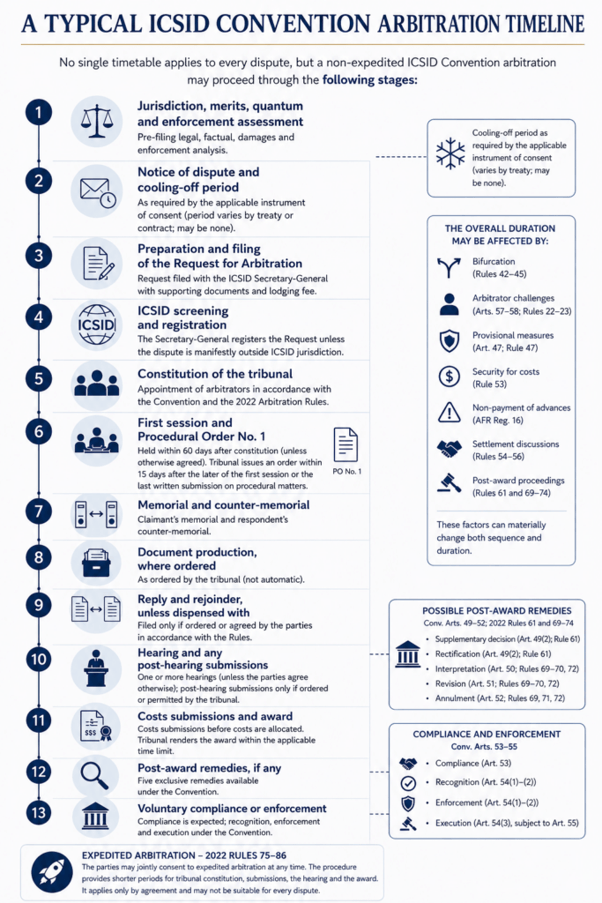
13. A Typical ICSID Arbitration Timeline
Although the procedure varies from case to case, most ICSID arbitrations follow a broadly similar sequence of stages. The timeline below provides a general overview:[51]
14. Common Mistakes in ICSID Arbitration
Even sophisticated parties can lose valuable time, increase costs or give up important procedural options through mistakes that could have been avoided. Common problems include:
- relying on the wrong instrument of consent or assuming that every company within a corporate group qualifies for treaty protection;
- missing a cooling-off period, waiver requirement, fork-in-the-road clause or treaty limitation period;
- failing to establish nationality, ownership or control at each date that matters for jurisdiction;
- restructuring the investment only after the dispute was, or should have been, foreseeable;
- treating registration as confirmation of jurisdiction or as an indication that the claim is likely to succeed;
- appointing an arbitrator without adequately assessing potential conflicts, availability, prior positions on relevant issues and existing professional commitments;
- preserving evidence too late or underestimating the time and cost involved in preparing the damages case;
- seeking documents that are broader than the issues in dispute justify; and
- treating annulment as an appeal, or waiting until after the award to investigate potentially reachable assets.
The broader lesson is that the case should be planned as a whole. Jurisdiction, procedure, evidence, damages and enforcement are closely connected, and early strategic decisions can shape the cost, duration and outcome of the arbitration.
Conclusion
A successful ICSID arbitration is usually built well before the Request for Arbitration is filed. Questions of consent, nationality, treaty preconditions, attribution, evidence, damages, funding and enforcement should be examined together from the outset. Once the case begins, decisions such as how the tribunal is constituted, what is agreed in Procedural Order No. 1, whether preliminary issues should be heard separately and how the evidence is presented can have a significant effect on both cost and duration.
The 2022 ICSID Rules provide a more detailed framework for case management, transparency, third-party funding, security for costs, bifurcation and the timing of awards. But procedural rules alone cannot make a case efficient. That still depends on early preparation, realistic assessment and disciplined advocacy throughout the proceedings.
Understanding how an ICSID arbitration develops, from the first notice of dispute through the award, any post-award remedies and possible enforcement, helps investors and States avoid procedural mistakes, preserve important evidence and make better decisions about settlement and strategy. Early advice is particularly important because jurisdictional options may narrow, evidence may become harder to obtain and potentially recoverable assets may become more difficult to reach.
Considering an ICSID claim or defence? Contact Aceris Law to request an initial case assessment. International arbitration is our singular focus.
[1] ICSID, ICSID Releases 2025 Caseload Statistics, 17 February 2026, https://icsid.worldbank.org/news-and-events/news-releases/icsid-releases-2025-caseload-statistics (last accessed 9 August 2026).
[2] Convention on the Settlement of Investment Disputes between States and Nationals of Other States, opened for signature 18 March 1965, entered into force 14 October 1966, Arts. 25, 53-55; 2022 ICSID Arbitration Rules, Introductory Note and R. 1; 2022 ICSID Additional Facility Rules, Arts. 2-4.
[3] ICSID Convention, Art. 25(1); Y. Kryvoi, International Centre for Settlement of Investment Disputes (ICSID) (5th edn., 2023), paras. 188-193.
[4] Report of the Executive Directors on the Convention on the Settlement of Investment Disputes between States and Nationals of Other States, 18 March 1965, paras. 23-30.
[5] Kryvoi, paras. 192-222; J. Fry and J. Stewart, Quick Answers on Arbitral Institutions – International Centre for Settlement of Investment Disputes (ICSID), Quick Answers on Arbitral Institutions, pp. 2-4.
[6] Kryvoi, paras. 193-195; ICSID Convention, Arts. 41 and 52(1)(b).
[7] A. Rahman and C. Stephen, Dispute Settlement III – Managing Disputes, in C. Tan et al. (eds.), Practical PIL: Public International Law and Its Implications for Businesses (2025), pp. 212-214; ICSID Convention, Art. 26.
[8] Rahman and Stephen, pp. 212-215; Kryvoi, paras. 713-715.
[9] ICSID Convention, Art. 44; ICSID Arbitration Rules, R. 1(1).
[10] M. Kinnear, A User’s Guide to What’s New in the ICSID Rules 2022, in C. Bull et al. (eds.), ICCA Congress Series No. 21 (Edinburgh 2022): Arbitration’s Age of Enlightenment? (2023), pp. 316-318.
[11] ICSID Additional Facility Rules, Art. 4; 2022 ICSID AF Arbitration Rules, R. 1(4); Kinnear, pp. 317-318.
[12] ICSID Additional Facility Rules, Art. 3; ICSID AF Arbitration Rules, Rs. 1(3), 41 and 71(3); ICSID, Overview of Arbitration under the ICSID Additional Facility (2022 Rules), https://icsid.worldbank.org/procedures/arbitration/additional-facility/overview/2022 (last accessed 9 August 2026).
[13] ICSID, Services Provided by ICSID in Cases under the UNCITRAL Rules, https://icsid.worldbank.org/services/arbitration/uncitral/services-overview (last accessed 9 August 2026).
[14] ICSID, Number of Arbitrators and Method of Appointment – UNCITRAL Arbitration, https://icsid.worldbank.org/procedures/arbitration/uncitral/appointments (last accessed 9 August 2026); ICSID, Recognition and Enforcement – UNCITRAL Arbitration, https://icsid.worldbank.org/procedures/arbitration/uncitral/recognition-enforcement (last accessed 9 August 2026); ICSID Convention, Arts. 53-55.
[15] ICSID Convention, Art. 36; 2022 ICSID Institution Rules, Rs. 1-4; Fry and Stewart, pp. 2-4.
[16] ICSID, How to File a Request, https://icsid.worldbank.org/services/content/how-to-file-request (last accessed 9 August 2026).
[17] Aceris Law LLC, How to File an ICSID Request for Arbitration, 23 April 2020, https://www.acerislaw.com/how-to-file-an-icsid-request-for-arbitration/ (last accessed 9 August 2026) (providing a practical checklist); ICSID Institution Rules, Introductory Note and Rs. 1-7, in particular Rs. 1-4.
[18] ICSID Convention, Art. 36(3); ICSID Institution Rules, Rs. 5-7; Kryvoi, paras. 109-113.
[19] Fry and Stewart, p. 4.
[20] ICSID Convention, Arts. 37-40; ICSID Arbitration Rules, Rs. 13-21.
[21] ICSID Convention, Arts. 14, 57-58; ICSID Arbitration Rules, Rs. 19, 22-23.
[22] ICSID Arbitration Rules, R. 14; I. Torterola and F. Sharipov, The 2022 ICSID Arbitration Rules: Modernizing International Investment Dispute Resolution, 39(1) ICSID Rev. – FILJ 52, pp. 56-57 (discussing the 2022 Rules’ mandatory disclosure of third-party funding).
[23] ICSID Arbitration Rules, Rs. 27, 29 and 31; J. Walker and D. S. Jones, Practical Insights on Pre-hearing Conference – International Centre for Settlement of Investment Disputes (ICSID), Practical Insights on Arbitral Procedure.
[24] 2022 ICSID Administrative and Financial Regulations, Regs. 15-18; P. Živković, Practical Insights on Allocation of Costs – International Centre for Settlement of Investment Disputes (ICSID), Practical Insights on Arbitral Procedure.
[25] ICSID Arbitration Rules, R. 41; Torterola and Sharipov, pp. 53-54.
[26] ICSID Arbitration Rules, Rs. 42-45; J. R. Profaizer, Bifurcation, in A. E. Appleton and P. F. J. Macrory (eds.), Business Guide to Trade and Investment – Volume 2: International Investment (2018), pp. 155-158.
[27] ICSID Arbitration Rules, R. 47; M. Apostol, Provisional Measures, K. A. N. Duggal (ed.), Jus Mundi Wiki Notes, updated 29 April 2026, https://jusmundi.com/fr/document/publication/en-provisional-measures (last accessed 9 August 2026).
[28] ICSID Arbitration Rules, R. 53; R. Happ and S. Wilske, The New ICSID Arbitration Rules – Are They Really New? What’s the Catch?, 13 Korean Arb. Rev. 77, p. 81.
[29] ICSID Arbitration Rules, R. 46.
[30] ICSID Arbitration Rules, Rs. 5 and 30; Fry and Stewart, pp. 12-14 of the PDF.
[31] ICSID Arbitration Rules, Rs. 36-37; Kryvoi, paras. 119-122.
[32] ICSID Arbitration Rules, Rs. 38-40; Walker and Jones, Pre-hearing Conference.
[33] ICSID Arbitration Rules, Rs. 62-68; Happ and Wilske, p. 80.
[34] ICSID Convention, Arts. 62-63; ICSID Arbitration Rules, R. 32; Fry and Stewart, p. 10.
[35] Walker and Jones, Pre-hearing Conference.
[36] ICSID Arbitration Rules, Rs. 30 and 58; J. Walker and D. S. Jones, Practical Insights on Closing the Proceedings – International Centre for Settlement of Investment Disputes (ICSID), Practical Insights on Arbitral Procedure, p. 1 of the PDF.
[37] ICSID Arbitration Rules, Rs. 54-57; H. Risso, Discontinuance of ICSID Arbitration Proceedings, D. Müller (ed.), Jus Mundi Wiki Notes, updated 25 November 2025, https://jusmundi.com/en/document/publication/en-discontinuance-of-icsid-proceedings (last accessed 9 August 2026).
[38] ICSID Convention, Art. 48(1) and (3); ICSID Arbitration Rules, Rs. 34(1), 35 and 59(1)(i); 2026 ICC Arbitration Rules, Art. 37.
[39] ICSID Convention, Arts. 48-49; ICSID Arbitration Rules, Rs. 12 and 58; Fry and Stewart, pp. 18-19.
[40] ICSID Convention, Art. 61(2); ICSID Arbitration Rules, Rs. 50-52; Živković, Allocation of Costs.
[41] ICSID Convention, Arts. 48(2) and 49(1); ICSID Arbitration Rules, R. 60(1)-(2).
[42] ICSID Convention, Art. 53; ICSID, Updated Background Paper on Annulment, March 2024, https://icsid.worldbank.org/resources/publications/background-papers-annulment (last accessed 9 August 2026), paras. 3-5.
[43] ICSID Convention, Art. 49(2); ICSID Arbitration Rules, Rs. 11(1) and 61; J. H. Nedden and M. Hauser-Morel, Practical Insights on Correction and Interpretation of Awards and Additional Awards – International Centre for Settlement of Investment Disputes (ICSID), Practical Insights on Arbitral Procedure.
[44] ICSID Convention, Arts. 50-51; ICSID Arbitration Rules, Rs. 69-73; Nedden and Hauser-Morel, Correction and Interpretation of Awards and Additional Awards.
[45] ICSID Convention, Art. 52; ICSID Arbitration Rules, Rs. 69, 72 and 73; Updated Background Paper on Annulment, paras. 5, 48-52.
[46] Updated Background Paper on Annulment, paras. 33-34, 117.
[47] ICSID Convention, Arts. 41(1), 51(4) and 52(5)-(6); ICSID Arbitration Rules, Rs. 73-74; K. N. Gore, Practical Insights on Remission of an Arbitral Award – International Centre for Settlement of Investment Disputes (ICSID), Practical Insights on Arbitral Procedure.
[48] ICSID Convention, Arts. 53-54; C. Lotfi, Practical Insights on Setting Aside Procedure (New York Convention, Articles V(1)(e) and VI) – International Centre for Settlement of Investment Disputes (ICSID), Practical Insights on Arbitral Procedure.
[49] Maritime International Nominees Establishment v. Republic of Guinea, ICSID Case No. ARB/84/4, Interim Order No. 1 on Guinea’s Application for Stay of Enforcement of the Award, 12 August 1988, para. 25; Lotfi, Setting Aside Procedure.
[50] ICSID Additional Facility Rules, Art. 3; ICSID AF Arbitration Rules, Rs. 41, 70(4), 71(3) and 72; ICSID, Post-Award Remedies – Additional Facility Arbitration (2022 Rules), https://icsid.worldbank.org/procedures/arbitration/additional-facility/post-award-remedies/2022 (last accessed 9 August 2026).
[51] Torterola and Sharipov, pp. 53-54; ICSID Arbitration Rules, Rs. 75-86.
