

On 28 May 2026, the United States Supreme Court issued its unanimous decision in Flowers Foods, Inc. v. Brock, further clarifying the scope of the Federal Arbitration Act (“FAA”) § 1 exemption for transportation workers. The FAA requires courts to enforce private arbitration agreements. However, § 1 of the FAA provides an important exception for […]
News
Rwanda v. UK: PCA Tribunal Rejects Claims Over the Asylum Partnership Agreement

The PCA’s award in Rwanda v. United Kingdom turns a politically charged migration dispute into a careful lesson in treaty interpretation, diplomatic correspondence and the legal consequences of saying “acceptable” in a note verbale. Although the case arose from the Rwanda-UK Asylum Partnership Agreement (the “Asylum Partnership Agreement”), its importance extends beyond asylum policy. The […]
Indonesia’s New Commodity Export Regime: Resource Nationalism and International Arbitration
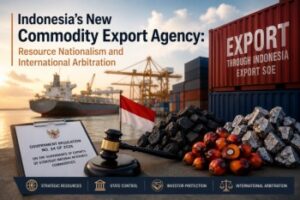
On 20 May 2026, Indonesia issued Government Regulation No. 24/2026 (PP No. 24/2026) (unofficial English translation here) on the Governance of Exports of Strategic Natural Resource Commodities (“Regulation”), which entered into force on 1 June 2026.[1] Under the Regulation, Strategic Natural Resource Commodities may only be exported by a State-owned enterprise (“SOE”) appointed by the […]
Key Changes in the 2026 ICC Arbitration Rules

The International Chamber of Commerce (the “ICC”) has now released the newest iteration of its arbitration rules, the 2026 ICC Arbitration Rules (the “2026 Rules”), which will enter into force on 1 June 2026. The 2026 Rules are evolutionary rather than revolutionary. The ICC has not fundamentally altered the structure of ICC arbitration, but it […]
Panama Canal Ports Dispute: Key Lessons for Foreign Investors

Disputes over critical assets now drive many international arbitrations. Ports, airports, energy projects, mining assets, data centres, telecom networks and transport corridors are no longer purely commercial assets. States increasingly link them to national security, economic sovereignty, supply chains and geopolitical influence. The Panama Canal ports dispute shows this trend clearly. Panama Ports Company, a […]
Can Misconduct in Arbitration Invalidate an Award?

International arbitration is often chosen because it offers parties a final and enforceable decision.[1] In most cases, that finality is one of its greatest advantages. However, an arbitral award is not immune from challenge.[2] Where serious misconduct has affected the proceedings, a party may be able to challenge the arbitral award before the courts of […]
Indus Waters Treaty Arbitration: Can India Put the Treaty in Abeyance?

The Indus Waters Treaty arbitration has become one of the most significant treaty arbitration developments of 2026. It is no longer only about dams, rivers or hydropower. It is a test of whether a State can put a treaty “in abeyance”, refuse to participate in arbitration and still avoid the legal consequences of an arbitral […]
The CEPANI 2026 Arbitration Rules

The Belgian Centre for Arbitration and Mediation (“CEPANI”) has adopted revised Arbitration Rules, which will enter into force on 1 June 2026 (“2026 CEPANI Arbitration Rules”). CEPANI states that the revision is intended to provide users with a more “modern, clear, and efficient” dispute resolution mechanism, with a particular focus on digitalisation, multiparty proceedings, sustainability, […]
UNCITRAL SPEDR Adjudication and the Construction Industry

Construction projects are uniquely vulnerable to disruption caused by unresolved disputes because interruptions in payment or performance during ongoing works can rapidly affect labour, procurement, subcontractor mobilisation, project sequencing, and ultimately project viability. Unlike many commercial disputes, construction conflicts frequently arise while contractual performance is still ongoing, meaning that delayed resolution may itself become a […]
