
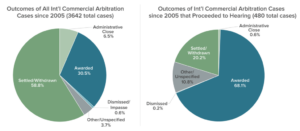
Contrary to what is often believed, most international arbitration cases are resolved through direct settlement between the Parties, or are withdrawn, with relatively few proceeding to a final oral hearing. According to Dispute Resolution Data, which analyzed 3,642 international commercial arbitration cases since 2005, 58.8% of international commercial arbitration cases that were initiated were either […]
ICC Arbitration
International Construction Arbitration in the Middle East

The construction industry is a leading economic sector in the Middle East, where a large number of infrastructure projects worth billions of dollars are commenced each year. Construction disputes are inevitable due to activity in the construction industry and arbitration is the preferred dispute resolution mechanism for such disputes, especially for foreign parties. Construction disputes […]
The Timing of Payment of Arbitration Advances on Costs
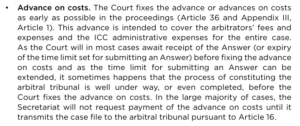
The payment of advances on costs in arbitration aims to ensure that an arbitral institution has sufficient funds to cover the payment of arbitrators’ fees and expenses, as well as costs incurred in the administration of arbitral proceedings. The advances on costs paid to arbitral institutions do not include party costs, such as legal fees […]
Drafting an Arbitration Clause in 2021 – Recommendations
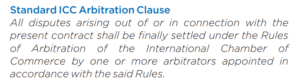
Many parties fail to realize that the wording of an arbitration clause is important for arbitration to function smoothly. In practice, one may observe, however, recurrent scenarios where arbitration clauses contain defective wording and, thus, are subject to unnecessary incidents and procedural debates. Such clauses are called “pathological clauses“. They are defined in Fouchard, Gaillard, […]
Rome I, Rome II, Applicable Law and International Arbitration

The relevance of the Rome I and Rome II Regulations for determining the law applicable to the merits of an international arbitration is a hotly-debated issue. Within the European Union (“EU”), Regulation (EC) No. 593/2008 on the law applicable to contractual obligations (“Rome I”)[1] and Regulation (EC) No. 864/2007 on the law applicable to non-contractual […]
Study on Damages in ICC Arbitration

On 10 December 2020, the Queen Mary University of London and PWC released a Study on Damages in ICC Arbitration Awards. The Study provides valuable data revealing, inter alia, how damages are approached and assessed by claimants and respondents, the role of experts in the assessment of damages and the approach taken by ICC tribunals […]
ICC Arbitration

ICC arbitration refers to the settlement of disputes under the Rules of Arbitration of the International Chamber of Commerce (the “ICC Arbitration Rules“). The International Chamber of Commerce (the “ICC”), which oversees ICC arbitration, is the largest and most diverse business organization in the world, with hundreds of thousands of member companies from over 100 […]
Revised 2021 ICC Arbitration Rules: Key Changes

On 8 October 2020, the ICC released an unofficial revised version of its Arbitration Rules (the “2021 ICC Rules”). The text of the draft 2021 ICC Rules remains subject to editorial corrections prior to its official launch in December 2020. The 2021 ICC Rules will take effect on 1 January 2021 and apply to all […]
Initiating Arbitrations Under Multiple Arbitration Agreements

The filing of arbitrations based on multiple arbitration agreements, contained in two (or more) separate contracts, in a single arbitration proceeding may be possible, but must be done with caution. The development of major projects in the fields of engineering, construction, oil and gas, and mining often give rise to situations where related disputes regarding […]
