

An arbitration clause in a contract is generally regarded as an autonomous agreement that may survive the termination of the contract that contains it. This presumption is often referred as “separability” or the “doctrine of separability”, according to which an arbitration clause is a “separate contract” whose validity and existence are independent from the substantive […]
United States Arbitration
Aceris Law Successfully Resolves ICC Arbitration Involving the Cryptocurrency Industry

The international arbitration boutique Aceris Law is pleased to announce that it has successfully resolved another dispute for another client, this time an arbitration concerning the cryptocurrency industry. Cryptocurrency arbitrations remain rare, but are likely to grow over the coming years as blockchain-related technologies become more mainstream. Cryptocurrencies are digital assets that serve as a […]
The United States District Court for the District of Columbia Confirms Enforcement of the Award in Micula
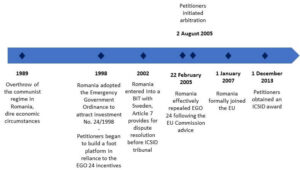
On 11 September 2019, the District Court of Columbia confirmed a 2013 ICSID award in favour of Mr. Ioan Micula and the companies in which he had invested. Romania repealed economic incentives the Micula brothers had relied upon when making investments in 1998. In 2013, an ICSID arbitral tribunal rendered an award in favour of […]
Confidentiality in International Arbitration: Obligations Under English, French and U.S. Laws

Confidentiality is often regarded as one of the core advantages of international arbitration. For instance, confidentiality reduces disclosure of sensitive information and the influence of public opinion.[1] Confidentiality is to be distinguished from privacy, which concerns the fact that only parties to the arbitration agreement may attend hearings and participate in arbitral proceedings.[2] Privacy prevents interference from […]
International Arbitration Agreements and Kompetenz-Kompetenz: A Comparative Perspective Between USA and France

The Kompetenz-Kompetenz doctrine presumes that an international arbitral tribunal has jurisdiction to assess and decide its own jurisdiction. Legal systems adopt different approaches to the Kompetenz-Kompetenz principle. National arbitration legislation varies regarding the versions of the Kompetenz-Kompetenz principle adopted.[1] The principle involves two types of effects. The positive effect of Kompetenz-Kompetenz is that the arbitral […]
Enforcement of Arbitral Awards against State Assets: Sovereign Immunity in the United States

The main issue related to enforcement of an arbitral award against a State in the United States is the State’s sovereign immunity. Under the Foreign Sovereign Immunities Act (“FSIA”), foreign sovereigns enjoy immunity from jurisdiction, a presumptive immunity from suit in U.S. federal and state courts, and immunity from execution, whereby their property is immune […]
Intra-EU Arbitrations and the Enforcement of ICSID Awards in the United States: the Impact of Achmea

The ICSID Convention requires signatories to treat arbitral awards rendered according to the ICSID framework as if they were a final judgment of a court in that State.[1] To challenge an award, the claimant shall seek review within the ICSID arbitral regime, rather than before State courts.[2] To implement the Convention, the U.S. Congress in […]
Economic Sanctions in International Arbitration
Issues concerning economic sanctions in international arbitration frequently arise. Economic sanctions are a commonly-used tool of foreign policy which can have a significant impact on the performance of parties’ contractual rights and obligations. While there are many ways in which economic sanctions may interfere with international arbitration, we will focus on the issue of the […]
Aceris Achieves American Clients’ Objectives in ICDR Arbitration
Aceris Law has again achieved the outcome sought by its clients, this time in an ICDR arbitration between European claimants and Aceris’ American clients. The ICDR arbitration, initiated by European claimants represented by a large corporate firm, were brought against Aceris’ clients and concerned claims of fraudulent misrepresentation, fraud in the inducement, negligent misrepresentation and unjust […]
