

Aceris Law is pleased to announce that it has assisted another client in succeeding upon its claims, in a decisive manner, in a SIAC arbitration taking place under Singapore law against the subsidiary of a large, publicly-listed company. The dispute, which had its seat in Singapore, concerned, inter alia, variation claims and claims for prolongation […]
News
Bifurcation in Investment Arbitration

In investment arbitration, it is rather common for arbitral tribunals to deal with preliminary issues prior to any consideration of the merits of a case. In such scenarios, the main question is whether to asses these issues together with other matters to be ruled upon in the final award or to deal with them in […]
Sovereign Immunity from Jurisdiction in International Arbitration

Sovereign immunity is divided into immunity from jurisdiction and immunity from execution.[1] The conditions under which these immunities apply are of particular importance in the field of arbitration. According to the French Supreme Court, sovereignty and independence of States prevent one of them from pursuing another.[4] In other words, national judges must refrain from ruling […]
Disclosure of Third-Party Funding Agreements in International Arbitration
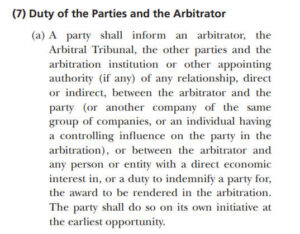
One heated debate concerning third-party funding in international arbitration is the disclosure of third-party funding, as third-party funders may be acting behind the scenes to finance an arbitration. Whether disclosure extends only to the funder’s identity or also to the integrality of the funding agreement, the question of disclosure is relevant to achieve a balance […]
The Recoverability of Arbitration Costs
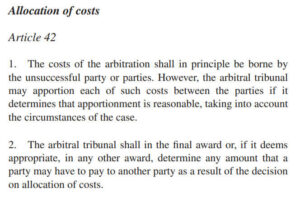
Costs tend to be a major concern for users of international arbitration. However, a successful party may recover them in full or in part, including the costs of legal representation. In this respect, both national arbitration legislation and institutional rules generally grant arbitrators the power to award the costs. Though the UNCITRAL Model Law is […]
Aceris Law Wins Another ICC Arbitration under Swiss Law

Aceris Law is pleased to have won another ICC arbitration under Swiss law for a European client regarding the construction of a cement plant in a West African State. Representing the Employer, the dispute concerned back charges, liquidated damages for delay and damages caused by the breach of the arbitration agreement. As usual, Aceris Law’s […]
Cybersecurity in International Arbitration

Cyberattacks in today’s digital world are becoming increasingly common and international arbitration has not remained unaffected. To the contrary, international arbitration can be highly susceptible to cyberattacks. This is explained by its very nature and underlying principles, namely privacy, confidentiality, procedural flexibility and the involvement of multiple players and sensitive data. In 2015, for instance, […]
The Recovery of In-House Costs in UNCITRAL Arbitration
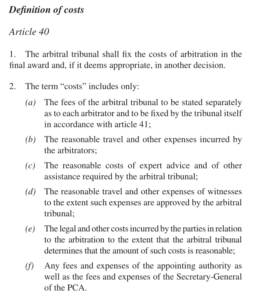
The 2010 UNCITRAL Rules (the “Rules”) provide for an exhaustive list of costs that may be considered by Arbitral Tribunals when ruling on costs.[1] Article 40 of the Rules provides that the recoverable costs of arbitration include legal and other costs incurred by the parties to the extent that the arbitral tribunal determines that these […]
How to Initiate International Arbitration

Initiating international arbitration is a rather simple process, which can be done by lawyers or even non-lawyers: In ad hoc arbitrations, normally, it requires only the service of a “Notice of Arbitration” to the respondent. In administered arbitrations, usually, it requires submission of a “Notice of Arbitration” or a “Request for Arbitration” before the competent […]
