
A inteligência artificial (IA) é o futuro e, de certa maneira, já faz parte das nossas vidas quotidianas e da arbitragem internacional. Apesar da resistência tradicional, a verdade é que a tecnologia entrou na arbitragem internacional através da videoconferência, dos registos eletrónicos, da utilização de ferramentas de digitalização de documentos e do recurso às bases […]
Investment Arbitration
Denial of Justice in International Investment Law

The principle of denial of justice embodies the maladministration of justice by local courts.[6] Prohibited acts of the local judiciary mainly revolve around access to justice, discrimination and the slow or non-existent execution of court decisions which are favorable to a foreign investor.[7] One of the oldest and most oft-cited definitions of denial of justice […]
The National Treatment Standard – Investment Arbitration

Violations of the National Treatment standard are often alleged by claimants involved in investment arbitrations. The National Treatment standard has a simple theoretical purpose: to ensure that foreign investors or their investments will be treated no less favourably than domestic investors or their investments. The application of the National Treatment standard can vary significantly depending […]
The Standard of Full Protection and Security for Foreign Investors

The standard of full protection and security is one of the basic principles of investment protection applicable to investor-State arbitrations. Its content, scope of application and the sanctioned behaviors of host States of investment can be diverse. Doctrinal Definition of the Standard of Full Protection and Security According to doctrine, the standard of full protection […]
Appellate Mechanisms for ISDS: Inconsistency & Unpredictability of Arbitration Awards

Investor-State Dispute Settlement (“ISDS”) has been criticized for the lack of an appellate mechanism and the inconsistency and unpredictability of certain arbitration awards that are rendered. Opponents of ISDS claim that, as decisions that may ultimately affect public interests are at stake, it is undesirable that wrong decisions taken by arbitral tribunals cannot be appealed. […]
Investor-State Arbitration: Who Qualifies as a Foreign Investor?

The simplest investment protections to understand, as well as the widest, are usually provided in Bilateral Investment Treaties (“BIT’s”). Protection via BIT’s is not granted to every foreign entity that is impacted by the measures of a host State of investment, however. In order to enjoy protection under BIT’s, business actors must qualify as investors […]
Valuation Date of Expropriated Investment in Investor-State Arbitration

The valuation date of an expropriated investment represents a crucial factor in assessing the amount of compensation to be paid in investor-State arbitrations, as the value of investments may change dramatically over the course of time. Arbitral tribunals are keenly aware that the value of investments change over time. For example, the Iran-US Claims Tribunal […]
The Salini Test in ICSID Arbitration

Article 25(1) of the ICSID Convention states that “[t]he jurisdiction of the Centre shall extend to any legal dispute arising directly out of an investment”. The manner in which tribunals have applied this provision has gradually evolved and has been subject to considerable debate. The Salini Test has been at the heart of this debate. […]
How Do Investment Arbitration Tribunals Interpret Investment Treaties?
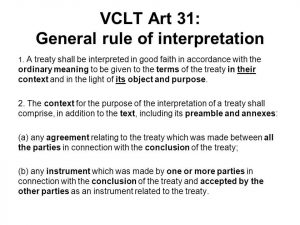
When interpreting a treaty provision, arbitral tribunals should first and foremost look at the “ordinary meaning of the terms”. This methodology is prescribed by Article 31 of the 1969 Vienna Convention on the law of treaties (VCLT). VCLT Articles 31-32 are codifications of customary international law. The interpretative approach prescribed by these articles should be […]
